Abstract
Why do we perceive movement in a static painting, and why do some images seem to move faster than others? Beginning in the early 1980s, and inspired by the pictorial dynamism of Wassily Kandinsky, I set out to answer these questions by mapping the perception of visual motion, term for term, onto the quantities of Newtonian mechanics. The Psycho-Vector series is the result: a sequence of paintings that leads a viewer through that mapping in stages, from the perception of shape to the perception of velocity, mass, momentum, force, and energy, and finally to the summation of these quantities across whole fields of form.
This paper presents the theoretical account of the series. It begins not with paint but with the body, using a simple demonstration in water to show how felt force and seen motion are fused into a single perceptual meaning that vision alone can later recover. It then shows how a single triangular form yields, to the trained eye, a measurable visual velocity (its slope), a visual mass (its area), and their products, and it follows the construction through to the vector summation of a field. The thread running through it is that this multisensory fusion is what allows configured shape to be experienced as carrying force, and that it is where the whole mapping begins.
1. Introduction
Two questions motivate the work described here. The first is why we are able to perceive movement at all in a static piece of artwork — why a fixed arrangement of marks on a flat surface should seem to surge, rise, or rush. The second is why some images are perceived to imply a greater velocity than others, so that one form reads as swift and another as ponderous though neither in fact moves. These questions are not merely psychological curiosities; they point to something fundamental about how vision carries meaning.
The paintings of Wassily Kandinsky taught a generation of viewers to see a canvas not as an inert arrangement of colored areas but as a field in motion. Lines advance and recede; a point presses on the plane that contains it; forms travel across the surface in different directions and, unmistakably, at different velocities. Kandinsky described these effects in a vocabulary of tension and inner life.
Studying Newtonian mechanics at the same time that I was looking at such pictures, I was struck by a correspondence that seemed to me more than language. If a painting can present motion that has both direction and magnitude, then it presents something formally identical to a vector; and if the eye can read differences of velocity across a surface, then it is already performing, intuitively, an operation that physics performs explicitly. The question that organizes the present work is whether the perceptual content of pictorial movement can be mapped, term for term, onto the kinematic and dynamic quantities of classical mechanics — position, velocity, mass, momentum, force, and energy.
The Psycho-Vector series was conceived as a way of walking through that mapping. Rather than asserting the correspondence, the paintings are arranged to lead a viewer through it in stages, and this paper follows the same staged path. I use the term psycho-vector to name the object of that perception — the felt-and-seen vector, a quantity of perceived motion or force that is at once a fact of the picture and a fact of the body that reads it. Before any claim can be made about paint, however, the perceptual phenomenon on which the whole series depends must be exhibited plainly. That is the purpose of the demonstration with which we begin.
A word on terminology. Throughout this paper, velocity, mass, momentum, force, energy and time used without qualification carry their ordinary physical meanings — the hand in the water, the two spheres, the egg in flight. Their counterparts in the picture are always named as such: visual velocity, visual mass, visual momentum, visual force, visual energy, visual time. The two are connected by the mapping set out below and by nothing else. A visual momentum is not a physical momentum that happens to be seen: it is a quantity of perceived motion, defined by the construction given here and measured in units of its own — which is why those units had to be invented rather than borrowed.
2. The merging of the senses: a demonstration in water
Consider an experience available to anyone with access to a swimming pool. Seated at the edge, one lowers a hand into the water and sweeps it back and forth. The character of the experience depends sharply on the orientation of the hand. When the broad face of the palm is held parallel to the direction of travel, so that the hand enters the water edge-on, the hand slices through with little resistance. When the palm is turned so that its broad face is normal — perpendicular — to the direction of travel, the same sweep meets pronounced resistance, and the hand drags a visible mass of churning water behind it.
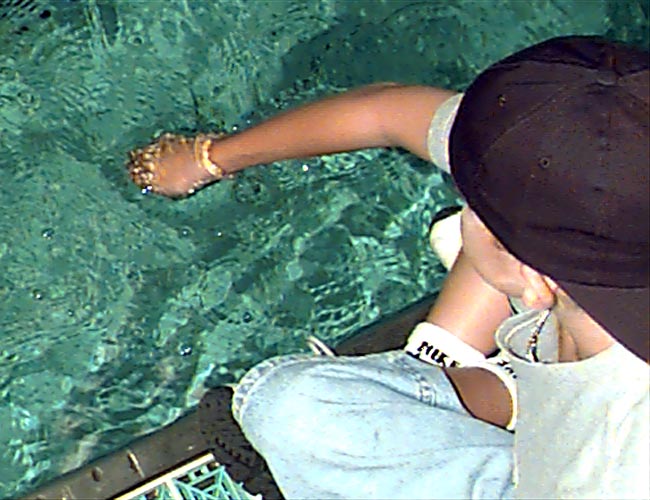
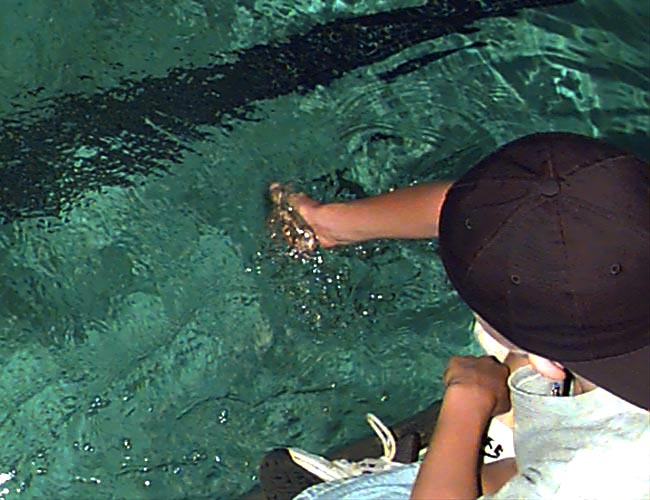
This contrast is not incidental; it reflects lawful differences in the interaction between a moving body and a fluid. Newton did not analyze the specific case of a hand turned edge-on and broadside, but in Book II of the Principia, devoted largely to motion in resisting media, he examined several of the physical principles underlying the experience. He considered resistance varying with the square of velocity and, for spheres moving through fluids, related resistance to the density of the medium, the square of the body’s velocity, and the square of its diameter—the last corresponding, for geometrically similar bodies, to frontal area. Elsewhere in Book II, Newton described how a moving body displaces the surrounding medium and how the fluid moves around into the space left behind it. He even invoked the familiar example of waves “excited by shaking a finger in water.” Modern fluid dynamics gives a more general and precise account of the resistance through the drag equation,
in which ρ is the density of the fluid, v the speed of the hand relative to the water, A the frontal area presented to the flow, and C-sub-d a dimensionless coefficient that encodes the influence of shape. Held edge-on, the palm presents a small frontal area and a low drag coefficient, and the resistance is slight; held broadside, it presents a large area and a high coefficient, and the resistance is large.
For a fixed muscular effort, then, the edge-on hand attains a markedly greater velocity, while the broadside hand moves slowly and spends its effort stirring a broad, turbulent wake. We register this difference twice over: we feel it as a difference in the load borne by the arm, and we see it as a difference in the water itself. The same event is delivered to two senses at once — and, crucially, it is delivered as one event.
The unity of these sensory aspects is essential to what follows. The resistance felt by the arm and the disturbance seen in the water are not initially given as separate reports that perception must subsequently compare and reconcile. They belong to a single embodied encounter with the water. Merleau-Ponty maintains that perception is “not a sum of visual, tactile, and audible givens” but an apprehension of a unified structure that addresses the senses together.1 As he writes elsewhere, the senses “intercommunicate by opening on to the structure of the thing.”2 The hand in the water therefore encounters neither a visual flow supplemented by a tactile load nor two sensations joined by inference: it encounters the resistance of the water, at once seen and felt.
The proposal advanced here is that repeated experiences of this kind educate vision. Because force has repeatedly been encountered through sight and bodily resistance together, optical structure alone can later recover something of the dynamic meaning of the complete event. This does not mean that force becomes visible as a separately existing thing, as though it possessed a color or surface. It means that force can become perceptually manifest through the movements, deformations, and relations that it produces.
Michotte’s experiments provide an important intermediate case. In his well-known launching displays, one abstract shape approaches another, makes contact, and stops or slows as the second begins to move. Observers do not ordinarily experience this as a neutral succession of displacements. They see the first shape launch the second: the sequence is immediately organized as a causal event (Michotte 1963). Michotte described this as an ampliation of the movement — the motion of the first form appearing to extend into the second. The perceived objects undergo no actual mechanical collision; they are elements in a visual display. Nevertheless, on Michotte’s account causal action belongs to what the observer sees rather than appearing only as a conclusion subsequently reasoned from it. Michotte’s displays thus indicate that vision can preserve the causal character of force after tactile resistance and physical interaction between the depicted objects have been removed.
Arnheim carries the argument from moving displays to static composition. On his account, pictorial forms are experienced as organized patterns of direction, attraction, balance, and tension. Forms press, pull, rise, recede, and counterbalance one another even though nothing on the painted surface physically moves. Arnheim’s “visual forces” are therefore not physical forces operating within the canvas, but neither are they merely decorative figures of speech. They name dynamic relations given in the perceptual organization of the composition (Arnheim 1974; 1982). Gibson, approaching motion through ecological optics, likewise argued that lawful transformations of the optic array specify movement and environmental events directly to an observer rather than supplying neutral sensory data from which motion must subsequently be inferred (Gibson 1979).
We can therefore distinguish three successive conditions. In the pool, actual force is felt in the arm and seen in the movement of the water. In Michotte’s displays, tactile resistance and actual mechanical contact between the depicted objects disappear, while visible motion continues to present causal action. In a static composition, even actual movement disappears, yet direction, tension, and implied motion remain perceptually available. At each stage something physical is removed while part of the event’s dynamic meaning is retained by vision.
This progression supplies the perceptual foundation of the Psycho-Vector series. A canvas does not push back. It offers the hand no resistance, no momentum, nothing that could be felt as force; it is pigment on a substrate, and all it gives the eye is the light its surface returns. Yet a lifetime of embodied encounters has schooled the eye to perceive movement, resistance, weight, and force through visible structure. The static image can therefore be experienced dynamically—not because the viewer mistakes it for an object that is physically moving, but because relationships within the image recover perceptual meanings first learned in an active, multisensory world.
3. Reading velocity from a form
With that foundation in place we can turn to form alone. Consider the pair of triangular figures that constitute the 1981 painting Equal Momentum Study of Isosceles Images with Seven Times Difference in Velocity: a narrow, spire-like triangle at the left and a broad triangle at the right, each rising from a common base toward the top of the picture. Let us deliberately restrict the viewing context to a single direction — upward, toward the top of the field — and regard the image as a flat, two-dimensional plane. The restriction is methodological: by collapsing the reading to one axis we obtain a scalar magnitude of motion, the visual counterpart of speed rather than of velocity in its full vectorial sense. We lift this restriction in Section 7.
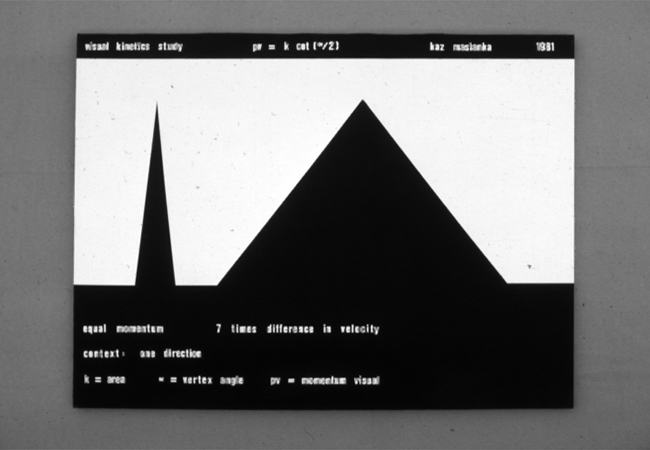
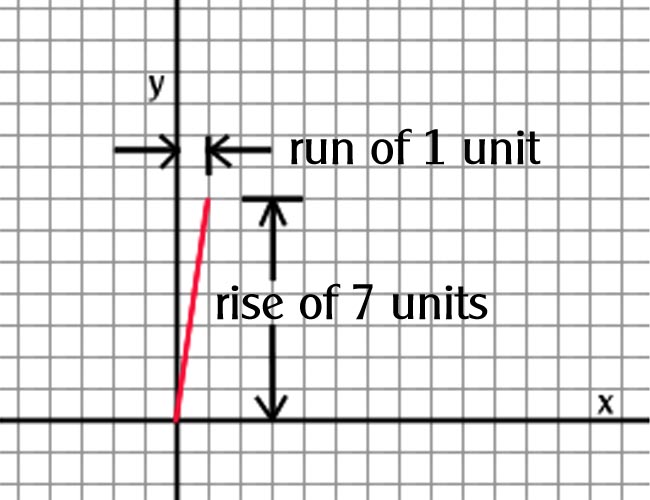
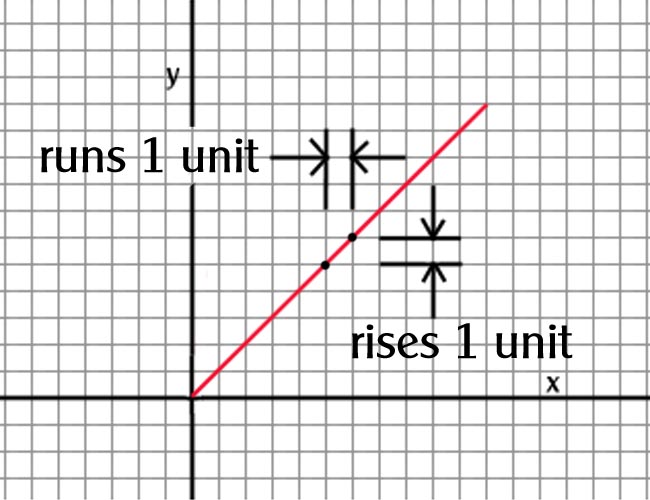
Asked which figure implies the greater velocity, almost every viewer chooses the narrow triangle at the left; it looks faster. The reason lies in the inclination of the sides that rise from the vertex. Those sides ascend toward the top of the picture more steeply than they spread toward its edges — they gain more height per unit of width — and the steeper that ascent, the greater the impression of speed. This is a quantity we can measure. Counting the units a side rises and dividing by the units it runs yields the slope,
For the narrow figure the side rises seven units while running one, giving a slope of seven. For the broad figure the side rises one unit while running one, giving a slope of one. We may therefore say, within the chosen context, that the left figure carries seven times the visual velocity of the right: it reads as travelling seven times faster. Visual velocity, on this construction, is the slope of the form’s bounding edge relative to the base of the picture.
4. Reading mass from a form
A second question may be put to the same pair: which figure is the more massive? Here the verdict reverses. The broad triangle at the right, covering by far the greater area, appears the weightier of the two. The judgment is as immediate as the judgment of speed, and it suggests a second correspondence: that the eye reads the area a form occupies as its visual mass. Visual mass, on this construction, is the area of the form. We now possess two readings drawn from a single shape — the triangle’s slope gives its visual velocity, its area gives its visual mass — and it remains to combine them.
5. Visual momentum
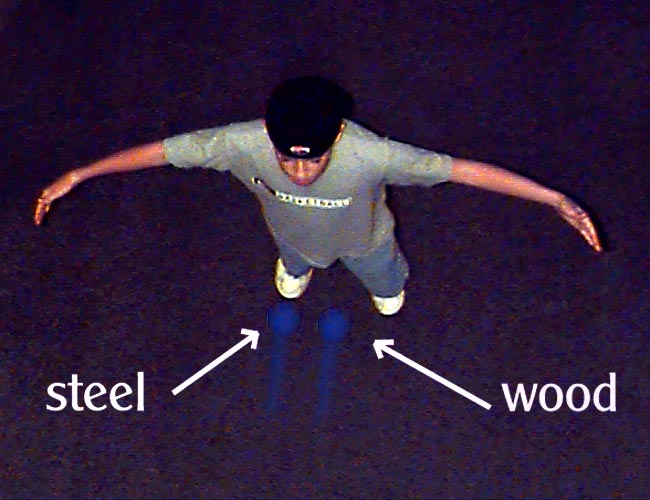
In mechanics, momentum is the product of mass and velocity. The quantity is easily felt. Imagine two spheres of equal size, one of wood and one of steel, thrown at the chest with the same speed. The steel sphere hurts more. Their velocities are identical; what distinguishes them is mass, and the greater mass of the steel sphere gives it the greater momentum. At equal velocity, more mass means more momentum — and the body registers the difference directly, just as it registered the difference of resistance in the pool.
By analogy, and within the one-directional context already established, we may define a visual momentum as the product of visual mass and visual velocity — that is, of area and slope:
It is worth replacing slope with an equivalent trigonometric expression, because doing so binds the quantity directly to the geometry of the form. A side rising from the apex makes an angle of half the vertex angle with the figure’s vertical axis; its slope relative to the horizontal base is therefore the cotangent of that half-angle. Writing alpha for the vertex angle, slope equals the cotangent of alpha over two. Letting K denote the area, visual momentum takes the form inscribed on the paintings themselves:
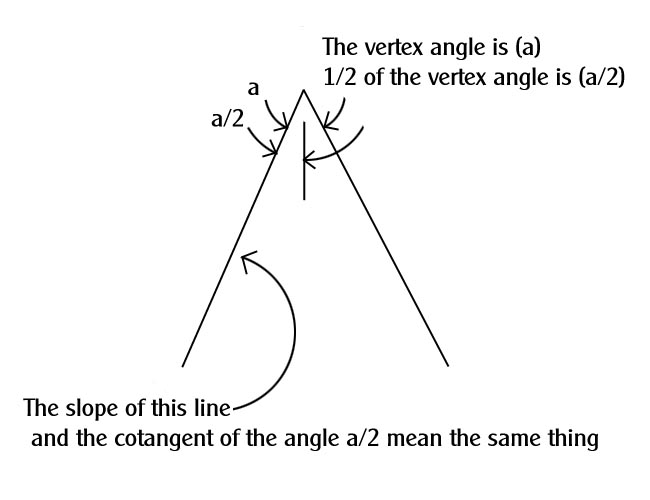
A quick check fixes the intuition: a vertex angle of ninety degrees gives sides at forty-five degrees and a slope of one, which is the broad figure, while a slope of seven corresponds to a vertex angle of roughly sixteen degrees, the narrow spire.
The formula is not merely descriptive; in Figure 3 it is constructive. The two triangles are proportioned so that their visual momenta are equal even as their visual velocities differ by a factor of seven. The narrow figure, with a slope of seven, is given one-seventh the area of the broad figure, whose slope is one; the two products coincide. The eye is thus presented with two forms that read as sharing a single visual momentum while one appears to move seven times faster than the other — a visible demonstration that velocity and mass trade off in perception exactly as they do in mechanics. More generally, any two isosceles images of the same height carry the same visual momentum: the greater area of the wider one exactly compensates the greater slope of the narrower one, and the bargain always balances.
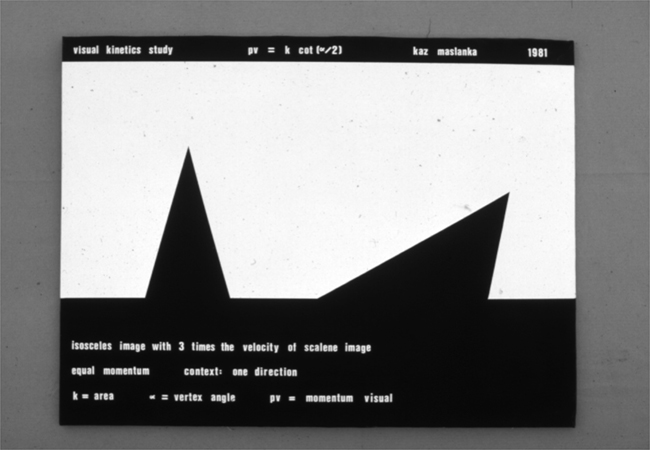
The construction need not be confined to isosceles forms. Figure 8 pairs an isosceles figure carrying three times the velocity of a scalene figure of unequal sides; once again the two are proportioned to share a single visual momentum. The principle is general: whatever the shape, the product of slope and area fixes the visual momentum the form conveys.
6. Visual force and visual energy
Physics defines force as the change in momentum per unit time. The meaning is vivid in the children’s game of egg toss, in which two players throw a raw egg back and forth, stepping apart after each catch; the team that throws and catches it over the greatest distance without breaking it wins. The whole art of the game is to bring the egg’s momentum from its maximum, in flight, down to zero, at rest in the hand, over the longest possible time. A player who lets the hand travel backward with the egg, slowing it gradually, spreads that change over a long interval and exerts little force; a player who stops it abruptly spreads the same change over a short interval and exerts a large force — and the egg breaks. To change a momentum over a long time is to apply a small force; to change it over a short time is to apply a large one.
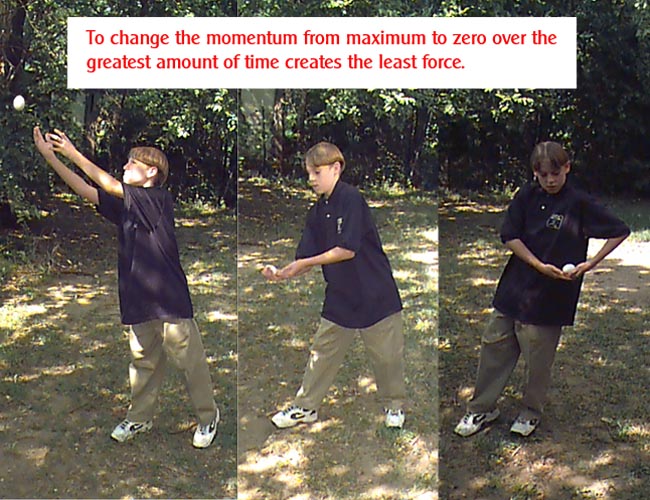
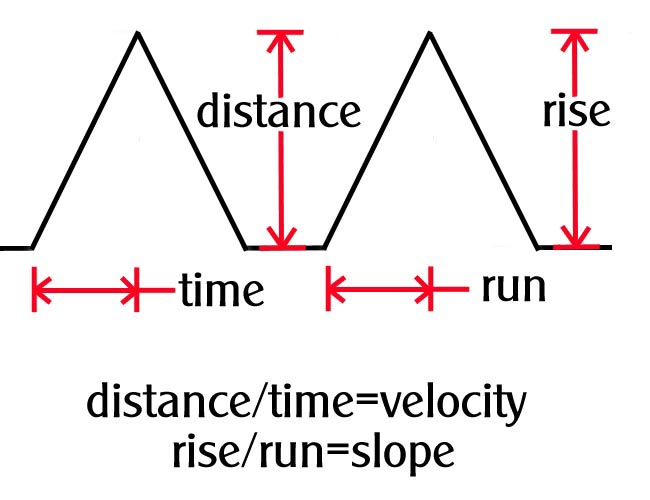
To carry this into the picture we need a visual time. The change in visual momentum is easy to identify — it runs from zero, where the form begins at its base, to a maximum, where it culminates — but the painting does not tell us directly how much time has elapsed. It does, however, imply a distance of travel, namely the height the form rises. Physics relates these by distance equals velocity multiplied by time. We already know the distance, which is the rise, and the velocity, which is the slope, so we may solve for the time.
Because slope is rise divided by run, and the run for a single side is half the base, the time this yields is exactly half the base of the triangular image. This is the temporal midpoint of the motion — the average of the initial and final times — so the full elapsed time, the final time, is twice that value, which we write as 2t. The result is consistent in both languages at once: velocity is distance over time in physics, and rise over run in visual kinematics, and the two readings agree.
With a visual time in hand, visual force is simply the maximum visual momentum divided by the time over which it is acquired:
And since physics defines energy as force times distance, the corresponding visual energy is
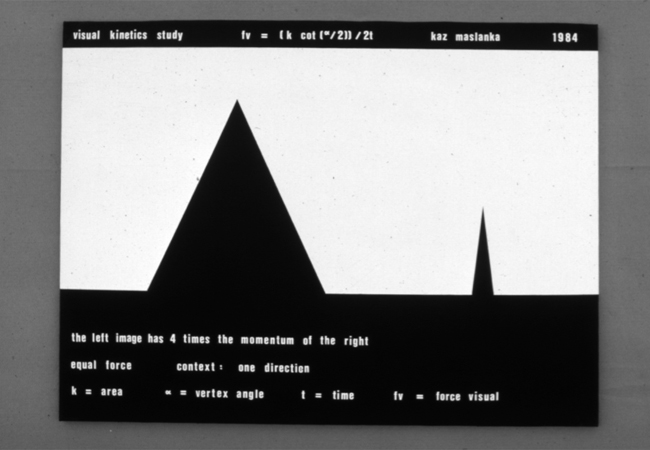
Just as a painting can be built to equalize visual momentum, it can be built to equalize visual force. Figure 11 pairs two figures in which the left carries four times the visual momentum of the right while the two share a single visual force — the larger visual momentum of the left being acquired over a correspondingly longer implied time, so that momentum-per-time comes out the same.
7. Pandirectional movement and vector sums
So far we have confined ourselves to movement in a single direction. A triangle, however, points three ways at once: each of its three vertices implies a motion outward along its own line, so the form in fact carries three movements rather than one. To combine them we need the idea of a vector.
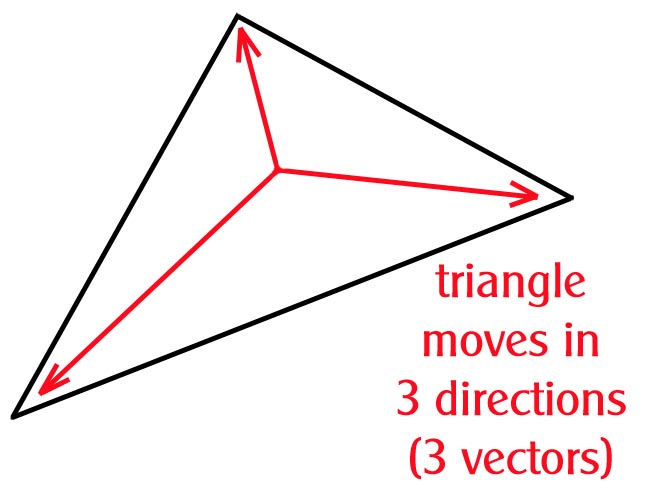
A vector is anything that has both a magnitude and a direction. A baseball thrown north at thirty miles per hour is a vector: thirty miles per hour is the magnitude, north the direction. A weight of two hundred and thirty pounds is a vector whose magnitude is the weight and whose direction is down. Each of a triangle’s three implied movements is likewise a vector, carrying a visual momentum, or equally a visual force, of a certain magnitude in a certain direction.
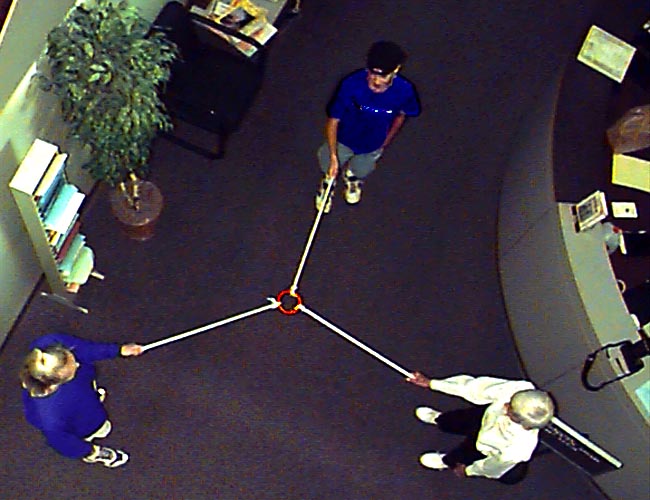
When several vectors act at once, their combined effect is found by adding them, and the sum is itself a vector. The addition is easy to feel. Imagine three people holding ropes tied to a single ring on the floor between them, each pulling outward toward themselves. Each pull is a force vector. If the two people in blue pull harder than the one in red, the ring does not move toward either of the two who pull hardest; it moves in a direction between them, settling where the three pulls balance. This combined magnitude and direction is the vector sum, and the single arrow that represents it is called the resultant.
Returning to the triangle, its three visual momentum vectors, or visual force vectors, may be added in just this way to find the resultant — the single direction and magnitude in which the form visually moves. Figure 14 makes the reading deliberately tricky. The dart-like figure at the left invites the eye to read it as moving down and to the right, toward its sharp point; but if we attend to the movement as issuing from the center of the form, the vector sum points up and to the left instead. The broad figure at the right is easier to read. In fact both figures move in the same direction, at one hundred and thirty-five degrees to the northwest as the inscription records, and with the same visual momentum magnitude.
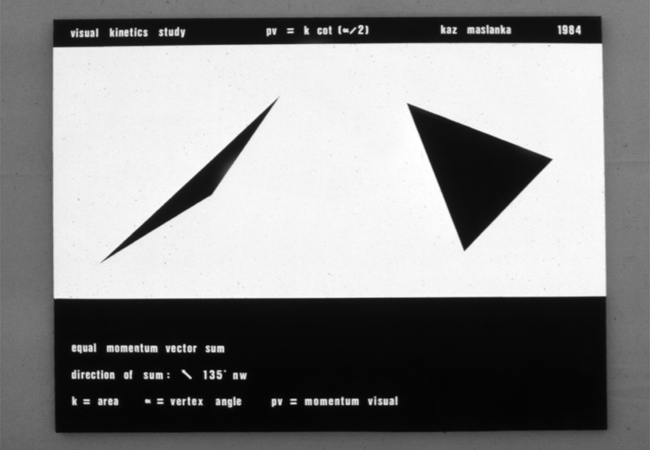
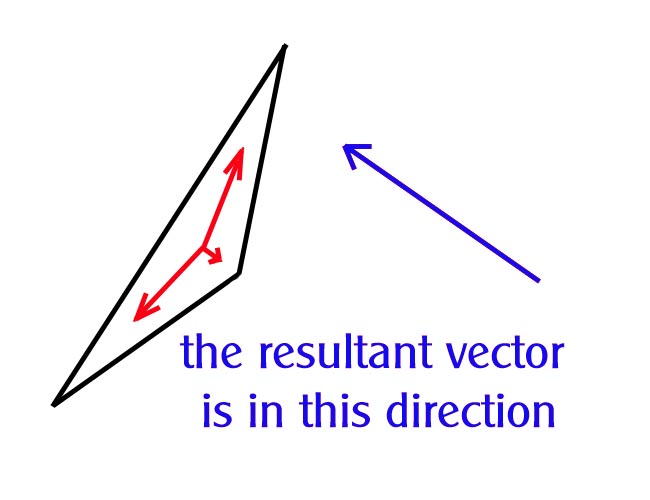
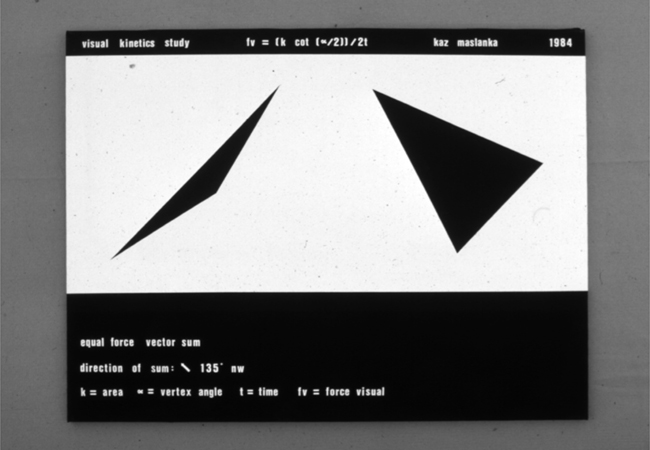
Figure 16 is the same study seen through the lens of visual force rather than visual momentum, its resultant again directed one hundred and thirty-five degrees to the northwest. Together the two works show that the whole apparatus of vector addition — magnitude, direction, resultant — applies to perceived motion exactly as it does to physical motion.
8. Fields of force: the Psycho-Vector paintings
The final three works of the series extend the summation from a single pair of forms to an entire field of triangles, adding their visual momentum and visual force vectors and summing their visual energies across the whole composition. Because there are no established units for quantities of this kind, I assigned them honorary ones, drawn from artists and poets whose work bears on the project: the chron for visual time, the Kandinsky for visual force, the Apollinaire per meter-chron for visual momentum, and the Matta for visual energy.
The choices are not idle — Kandinsky for the painter of pictorial force, Apollinaire for the poet whose Calligrammes made writing into a visual field, and Matta for the painter of cosmic energies.
Beneath each field the resultant visual momentum, visual force, and visual energy are inscribed as magnitudes and directions.
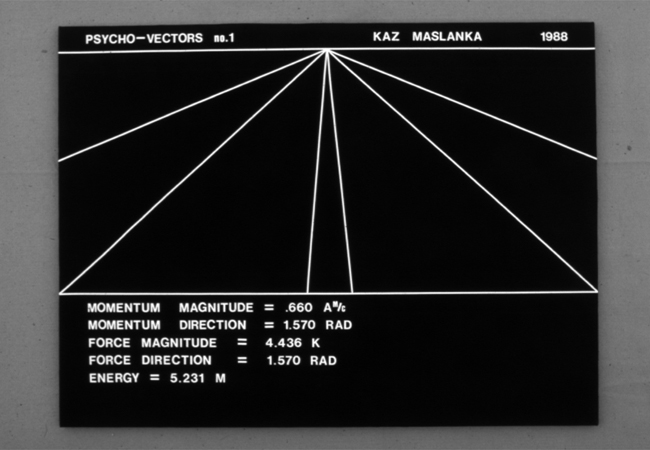
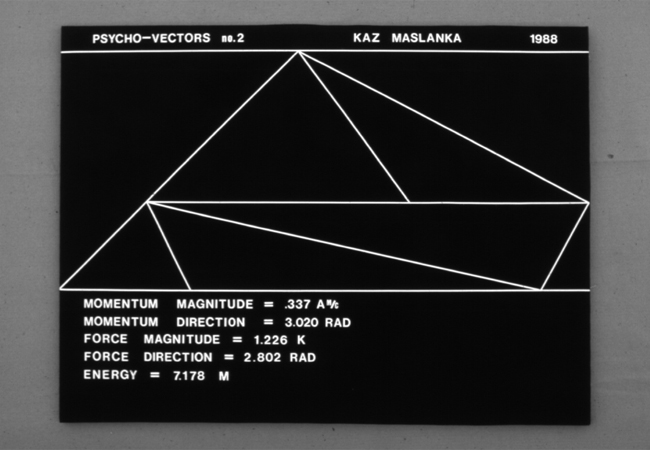
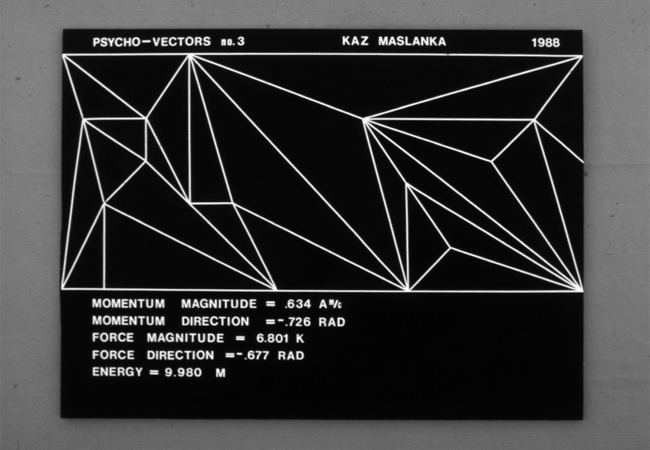
In these field paintings the program reaches its widest expression. A single triangle gave us visual velocity, visual mass, visual momentum, visual force, and visual energy; a pair let us equalize one quantity while varying another, and then introduced direction; a field lets us sum all of these at once into a single resultant that the composition as a whole conveys. What began as the felt resistance of water against a hand has become a calculable field of forces presented to the eye alone.
9. Conclusion
The series set out to answer why we perceive movement in a static image and why some images imply greater velocity than others. The answer it offers is that perception is multisensory at its root: because felt force and seen motion are fused into one meaning in lived experience, vision alone can afterward recover the whole, and a configured form can therefore deliver visual velocity, visual mass, visual momentum, visual force, and visual energy to a viewer who never touches it.
The Psycho-Vector paintings make that delivery exact. They assign visual velocity to the slope of an edge, equivalently the cotangent of half the vertex angle, and visual mass to the area enclosed, and then build from these the visual momentum, the visual force, and the visual energy — finally summing these as vectors across whole fields of form.
The aim has not been to reduce painting to physics but to show that the eye, schooled by the body, already reads pictures in something very close to the language of mechanics, and that a painter can compose in that language deliberately. Kandinsky intuited as much when he wrote of the tensions and movements of points and lines. The Psycho-Vector series attempts to give that intuition a measure.