For forty years I have been arguing one thing: that an equation can carry a metaphor. That the structure a physicist uses to describe a falling body will also describe grief, or ego, or the worth of a sunset — and will describe it more precisely than prose can. These are the nine that argue it best. They are here because the argument in them is still working, and because, one way or another, the world outside my studio agreed.
When you were four, a summer lasted forever. It doesn’t anymore, and nothing about the summer changed.
I first noticed this at about eight years old, and it terrified me: I was going to be in school until I was eighteen, and eighteen was an eternity away. Then I turned eighteen and hardly any time had passed at all.
The explanation I arrived at in 1983 is that we judge a span of time against how much time we have already had. One year is a tenth of a ten-year-old’s life and a sixtieth of a sixty-year-old’s — and one tenth of your life is an enormous piece of time next to one sixtieth. A forty-year-old experiences twenty years about the way a twenty-year-old experiences ten. Each of them is reflecting on half a life.
What made it a poem rather than an observation is what I did next. That shrinking ratio has the same shape as Einstein’s time dilation — the slowing of a clock aboard a ship approaching the speed of light — so I mapped one onto the other and wrote it as a computer program. Enter your birthday and a parent’s, and the piece will tell you how fast their clock is running relative to yours, and then how close to light speed a ship would have to travel to reproduce, physically, the difference the two of you already live with.
It was written on a Radio Shack Color Computer — thirty-two columns, sixteen rows, capital letters only — at a time when using an equation from physics as a vehicle for poetic metaphor was not a thing anyone was doing. It has been carried across three machines and forty-three years to reach you: CoCo in 1983, IBM 8088 in 1988, the web in 2026.
Push the frame of reference out toward eternity and the two clocks almost agree — but never quite. Sameness is the limit, never the arrival.
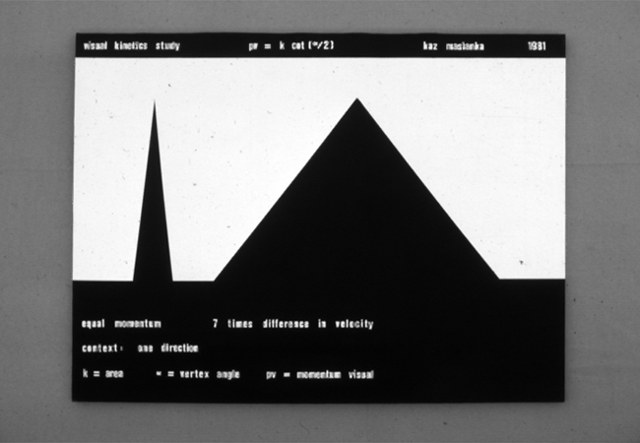
Look at the two shapes beside this text. One of them is moving faster than the other. Neither of them is moving at all.
Kandinsky taught a generation to see a canvas as a field in motion — lines that advance and recede, a point pressing on the plane that holds it, forms crossing the surface at visibly different speeds. But he described all of it in the vocabulary of tension and inner life. I was studying Newtonian mechanics at the same time I was looking at those pictures, and I became convinced the correspondence was more than language. A painted movement has both magnitude and direction; that is not like a vector, that is the definition of one.
So the series takes the correspondence at its word and follows it through, in stages you can follow with your own eye. Let a triangle’s slope be its visual velocity. Let its area be its visual mass. Multiply the two and a visual momentum falls out that can be calculated — which means two figures can be built to carry identical visual momentum while one of them reads as seven times faster, and the eye recognizes the trade the moment it is pointed out. Read visual time off the form and visual force follows. Add the distance and you have visual energy. Restore the missing directions and whole fields of triangles resolve into a single resultant.
Those last three paintings, made in 1988, have their totals inscribed along the bottom edge in units that did not exist and had to be named: the chron for visual time, the Kandinsky for visual force, the Apollinaire for visual momentum, the Matta for visual energy.
The whole argument starts with a hand in a swimming pool — and the reason a canvas, which offers nothing at all to the hand, can still deliver a force to the body that reads it.
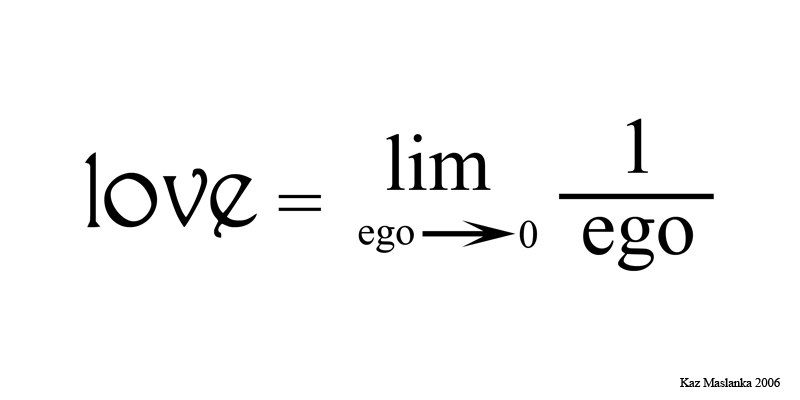
Nine characters, and I have never written anything truer.
Read it out loud: love equals the limit of one over ego, as ego approaches zero. A fraction with a shrinking denominator grows. Halve the ego and you double the love; halve it again and double it again. Drive the ego down toward nothing and the love climbs without any ceiling at all.
The mathematics is doing real work here, not decoration. It is not saying that a selfless person loves more. It is saying something far less comfortable — that love and ego are inversely proportional, that every unit of self you insist on is a unit of love you have priced yourself out of, and that the exchange rate is not negotiable.
And then the limit does the last thing, the thing prose cannot do in nine characters: you cannot actually divide by zero. Infinite love is not a state anyone occupies. It is a value the function approaches as the self goes to nothing — real, exactly specified, and permanently out of reach. Sacrifice is the whole of the operation. Bliss is what the operation approaches.
Every mystic in every tradition has said this. None of them said it in nine characters.
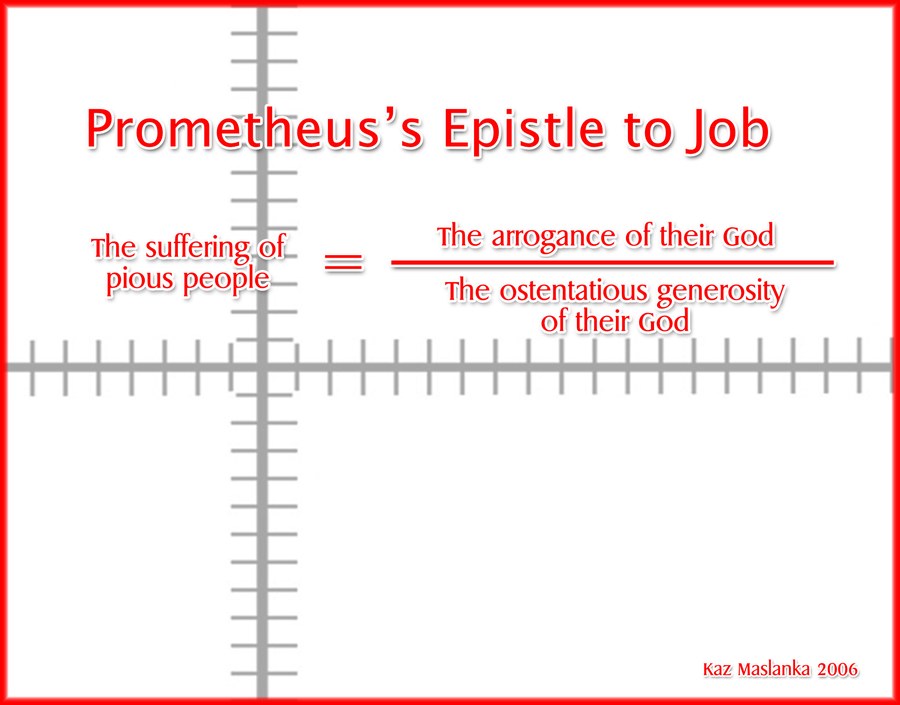
Two men suffer not by accident but by decree. Only one of them asks why.
Job is stripped to ash on a wager, lifts his face, and asks the one question left to him. What comes back out of the whirlwind is not an answer — it is scale. Where were you when I laid the foundations of the earth? Job goes quiet, not because he understands but because he has been outmatched.
Prometheus is chained in open sky with an eagle at his liver, and the story says he was offered the same deal every tyrant offers: apologize, and this stops. He laughs. Apologize for fire? For handing men the means to think? There is no why in Prometheus — only: I would do it again.
The poem is the letter the second man never sent the first, and it is one line: the suffering of pious people equals the arrogance of their God divided by the ostentatious generosity of their God. Read what the structure commits to. Suffering scales directly with divine arrogance. It scales inversely with display — so as the visible generosity of a God approaches zero, the suffering of the people who kept faith with him increases without bound.
Job never got an answer. He got a denominator.
An old pond. A frog jumps in. The sound of water. Seventeen syllables that have outlasted four centuries of translators.
Every English rendering of Bashō loses the same thing, because the poem was never about a frog or a pond. It is about the instant stillness breaks, and about what is left listening when it does. Translation keeps the frog and drops the instant.
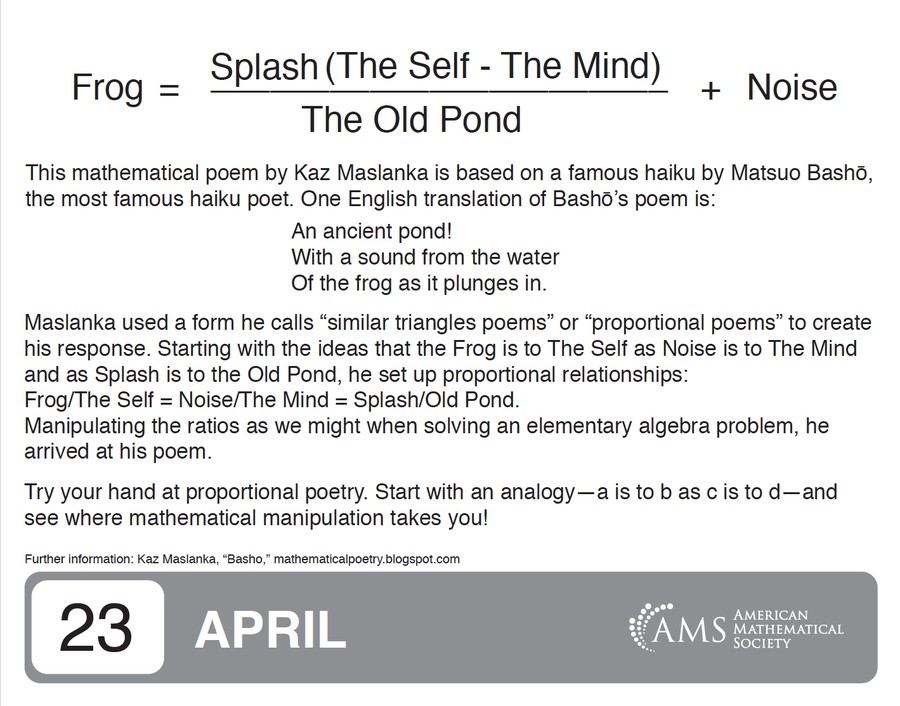
So I did not translate it. I built it as an expanded similar triangles poem — my proportional form pushed past its usual two ratios to three. Six terms, not four: Frog is to The Self as Noise is to The Mind as Splash is to the Old Pond. Three ratios, all equal.
The expansion is what buys the next move. Subtract one numerator from another and subtract their matching denominators, and the difference still holds the proportion: (Frog − Noise) over (The Self − The Mind) equals Splash over the Old Pond. Solve that for Frog and the equation on the left falls out on its own — I did not compose it so much as discover what the proportion had already committed me to.
And the commitment is this: the distance between the frog and the noise stands to the distance between the self and the mind as the splash stands to the old pond. The disturbance and the stillness it disturbs are not opponents. They are held at a fixed rate, and that rate is the poem.
The mathematicians took this one. The poets took the one beside it. Living in the crack between two genres has never been a popular address, but nothing in this room could have been made anywhere else.
I had been putting words on a coordinate axis for ten years. In New York I finally got to walk around inside one.
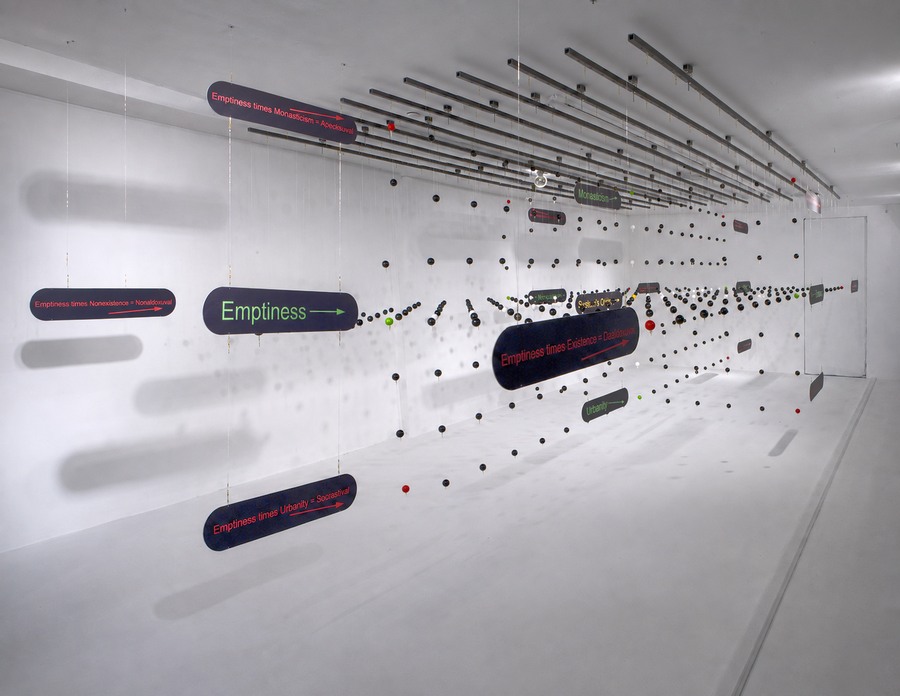
The jewels in the title are the Three Jewels of Buddhism, and each is given an axis running between its two polar extremes: Emptiness against Thinking (Buddha), Existence against Non-existence (Dharma), Monasticism against Urbanity (Sangha). Three word axes, set orthogonal to one another at the scale of a room.
Mapping them into a Cartesian space is the whole move. Three jewels stated as doctrine are three separate ideas. Three jewels stated as coordinates become a continuous gradient — every location in that gallery is some proportion of all three at once, and there is no point in the space that isn’t.
Then the arithmetic. Multiply each pole by every pole that does not lie on its own axis and twelve products fall out, so the piece is built from twelve orthogonal space poems in the A = B × C form, arranged contiguously in one coordinate system — a Dodecaorthogonal Space Poem. What is new in it is that one variable in every poem is a word I fabricated: Socrastival, Apecksuval, Doalldoxuval. Their meaning is nothing but the operation performed on the other two.
To read the room: the yellow sphere is the origin. The green spheres are the concepts sitting on the axes. The red spheres mark where each poem begins, and the poem itself occupies the plane between that red sphere, its two adjacent green spheres, and the origin.
A visitor walking that room was not looking at the coordinate system. They were a point inside it, holding some measure of all three jewels whether they cared to or not.
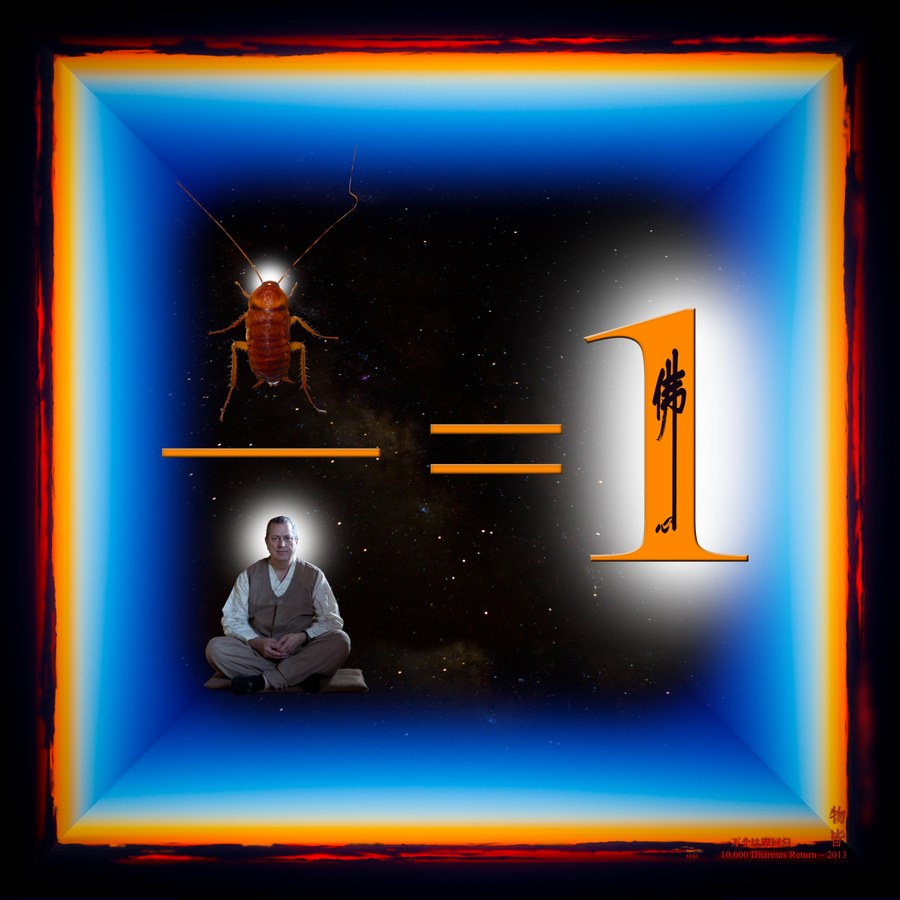
The ten thousand dharmas return to the one. To what does the one return?
That is Zhaozhou’s question, and it has been handed to students for a thousand years precisely because it cannot be answered by thinking harder. My answer is the simplest arithmetic there is: anything divided by itself equals one.
So the numerator is a cockroach who crossed my sidewalk in San Diego, and the denominator is me, sitting zazen. The line between them is a division bar and it is doing the entire argument — because if the quotient is one, then the two terms are not merely alike, they are not different. Any other reading breaks the equation. You are welcome to reject that. You are not welcome to reject it and keep the arithmetic.
The rest of the image sets the scale of the claim. The star field behind them is the space between Scorpio and Sagittarius — the center of our galaxy. The border is built from a sunset I shot through an airplane window. Down the stem of the numeral, brushed in black, are the characters 佛心: Buddha’s mind. The seal in the corner reads 物皆, Mool Kae, my Korean dharma name.
Let the self approach zero, and the quotient climbs without bound. In Chinese, 10,000 means infinity: the infinite dharmas return to the one, and the one returns to infinity.
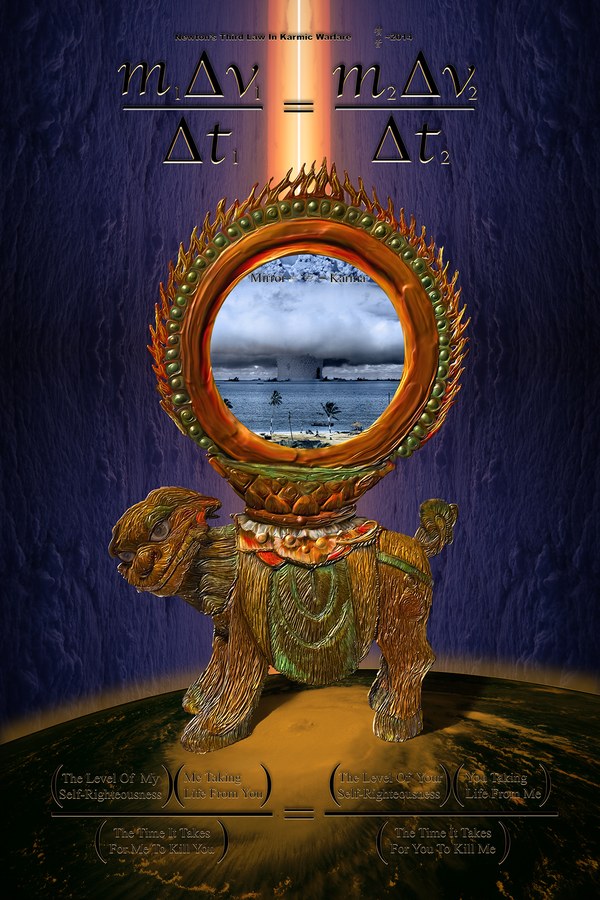
What goes around comes around is not a proverb about justice. It is a claim about forces, and it can be written as one.
Newton’s third law says that for every action there is an equal and opposite reaction: two forces, matched, pointed at each other. Karma says the same thing in the vernacular. So I set one law equal to the other and let the substitution do the rest.
Open up each force. Force is mass times acceleration, and acceleration is a change in velocity over a change in time, so both sides become mΔv/Δt. Then the words go in. Mass becomes the level of my self-righteousness. The change in velocity becomes me taking life from you. The change in time becomes the time it takes for me to kill you. The other side is the identical sentence with the pronouns reversed.
Then the image found itself. Korean and Chinese Buddhism has the karma mirror — the glass in which the dead are shown their own acts in the Bardo state. I painted the Joseon dynasty mirror held by the Los Angeles County Museum of Art, a flaming ring carried on the back of a lion. And only once it was built did I see what had been sitting at the center of the equation the whole time, so I wrote it across the glass: Mirror = “=” = Karma. Three reflections set equal. The mirror reflects image, the equals sign reflects value, and karma reflects action.
What the mirror shows is the atomic test at Bikini Atoll. The eyes of the lion are mine.
The equation balances. It has no way of saying which of us started it.
Genesis says the apple is punishable by death. Thermodynamics says the universe is running down. I want to know whether those are two facts or one.
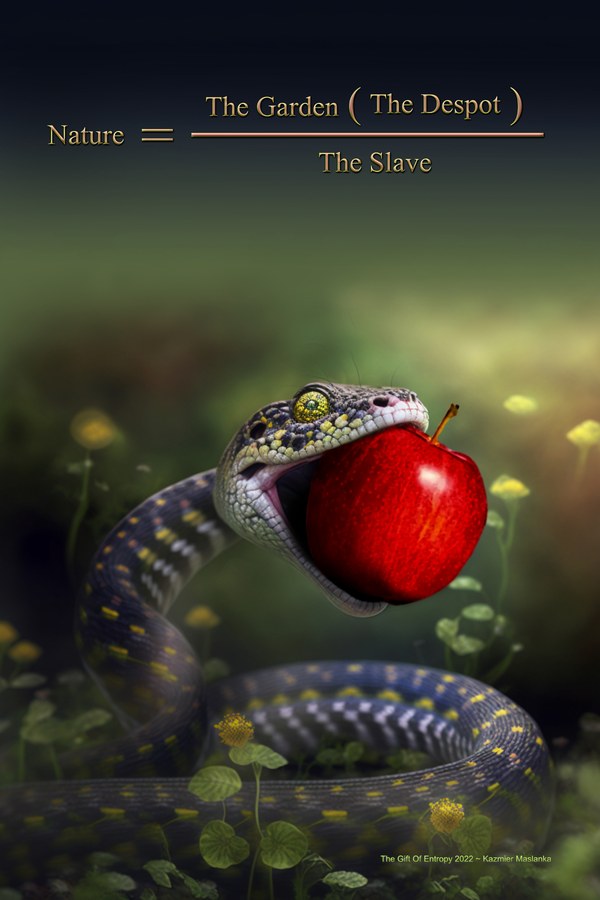
Entropy is usually defined as the degradation of matter and energy toward a state of inert uniformity — the general trend of the universe toward death and disorder. The image is Genesis 2:17, the snake holding out the fruit of the tree of knowledge, and the eating of it costing Adam and Eve, and the rest of us, our immortality. Set the two side by side and a question opens that I cannot close.
If you believe in a creator God, then the creator embedded entropy in the world, and entropy is the death sentence of the universe — so what is the apple, and who gave it? God, Nature, or Satan. It can be argued that Augustine invented free will in order to move the blame for evil off the creator and onto the created. This piece asks whether physics has quietly taken that argument out of theology’s hands.
The poem is a similar triangles poem: Nature is to The Garden as The Despot is to The Slave, solved here for Nature. Read the equals sign as the word is and the metaphor maps straight across it — the despot and the slave are the concrete source, nature and the garden the abstract target — while the image of the garden blends with the word until you cannot say which one you are reading.
Václav Havel: “Just as the constant increase of entropy is the basic law of the universe, so it is the basic law of life to be ever more highly structured and to struggle against entropy.” We have no choice but to fight it every second, and we lower our own entropic state at our neighbour’s expense. Nations hoard energy; the oil wars are the example to hand. If that is right, the utopian ideal cannot exist, because entropy holds us in check.
I still cannot decide whether the apple was a sentence or a present. The title takes a position. The poem does not.
More of the historic work is being brought over as it is scanned and written up. The current work lives on Substack, and the rest of the archive is on the legacy site.