The four spaces
Cognitive linguists Gilles Fauconnier and Mark Turner argue that a great deal of ordinary thought works by blending: two mental spaces are held at once, a shared skeleton is recognised between them, and selected pieces of each are projected into a third space where something exists that was in neither original. The blend is not a compromise between the inputs and it is not their sum. It has structure of its own.
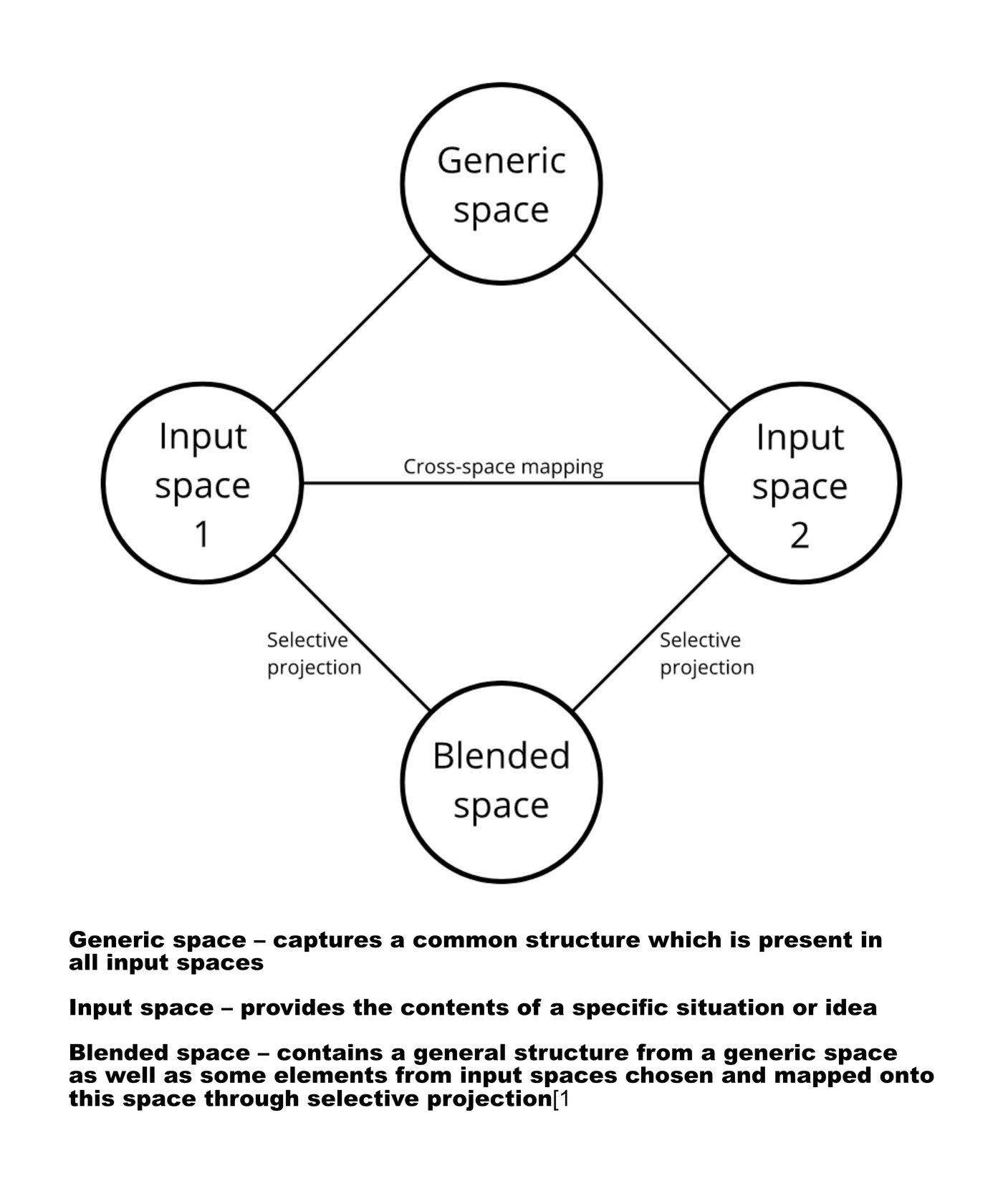
- Generic space — captures a common structure present in all the input spaces.
- Input space — provides the contents of a specific situation or idea.
- Blended space — contains the general structure from the generic space along with elements selected from the inputs and mapped in through selective projection.
The last of those is where the work gets done. Selective projection means the blend is partial by nature: not everything comes across, and what does come across arrives without its old context. That is exactly the condition under which a reader has to think.
Why an equation is a good place to do it
An equation is unusually good at forcing a blend, and it does it with the equal sign. Put two concepts on either side and the notation asserts that they correspond — it does not ask whether they can. The reader is handed the cross-space mapping already made and has no choice but to look for the generic space that would justify it.
Multiplication does something stronger still. Add two concepts and they stay separable; you can see the seam. Multiply them and they integrate, and the product has a magnitude neither input had alone. That is a blend in the strict sense, and it is why the orthogonal space poem reads the way it does.
Nothing here is a form I invented. Blending is a description of how minds already work, from Fauconnier and Turner. What I claim is only that mathematical structure is an unusually efficient vehicle for it — and that once you notice it running underneath the taxonomy, the taxonomy stops being a list of eight separate things.
Blending without a structure
Some of my pieces have no equation form under them at all. They are not mathematical visualisation in the sense that much of the work shown at Bridges is mathematical visualisation — nothing is being depicted. They are blends, and often the visual material is one of the inputs rather than a wrapper around it.
Golden Mobius is the clearest case. The statement 1 + 1 = 1 is engraved around a surface that has one side where you expect two, so the material and the arithmetic are making the same claim by different means. Then the object is gold, and the gold is not decoration — it is a third input, carrying everything gold carries, projected into the same blend.
Keeping Score puts fractions where a description of wanting somebody should be. Seven eighths plus seven eighths does not equal one, and the male and female symbols are drawn as pies missing a slice. The arithmetic is correct and it is not the point; the point is what correctness does to the sentiment.
What Is The Radius Of His Compassion? puts a raised middle finger where the radius of a sphere should be, and asks for the volume. The gesture and the radius are the same object, measured two ways. Nothing is borrowed from the world here — the sphere is a mathematical identity, not a model of anything — so the poem is a blend and not a paradigm.
The Question of De Chirico holds up two notations side by side — De Chirico(Baltimore) and De Chirico + Baltimore — and asks whether they say the same thing. One is a function applied to an argument, the other a sum. The piece never answers. It is a question about how blending itself is notated.
Mixed cases
Blending is not exclusive with the forms in the taxonomy, and the pieces that make this plainest are the ones doing both at once. Americana Mathematics runs an orthogonal space poem — addition and multiplication of the same two terms, giving two different results — while every term in it is itself a blend of a racing number with a billiard ball. Lao Tzu’s Postulate borrows a whole physical model the way a paradigm poem does, then blends ego and Tao into the two waves it puts out of phase.
So a work can be catalogued by its structure and still be described by its blending, and the two answers do not compete. The taxonomy tells you the shape of the container. This page tells you what the container is for.
Pieces that run primarily on blending
- Mask of God 1987
- Lao Tzu’s Postulate 2004
- Americana Mathematics 2006
- The Question of De Chirico 2008
- Golden Mobius 2010
- Keeping Score 2012
- What Is The Radius Of His Compassion? 2018
- Lao Tzu’s Postulate 2020
Reference
- Gilles Fauconnier and Mark Turner. The Way We Think: Conceptual Blending and the Mind’s Hidden Complexities. Basic Books, 2002.
- K. Maślanka. “The Gift of Entropy.” Bridges 2024 Conference Proceedings — where I work a single poem through its blends in detail.
- K. Maślanka. “A Cognitive View of Pandemic Meditation.” Journal of Humanistic Mathematics, vol. 12, issue 1, 2022.