1 A rate is a comparison of two changes
Start with something you already know. A car covers 120 miles in 2 hours. Its average speed was 60 miles per hour — you divided the change in distance by the change in time.
That is the whole idea, and calculus never leaves it. A rate is always a comparison of two changes. Mathematicians write “change in” with the Greek capital delta, Δ, so the speed is Δdistance ⁄ Δtime. When you see Δ, read it as “the change in.” It is not a multiplication and it is not a mystery.
Notice the word average. Over those two hours the car may have stopped for petrol and later done ninety. Sixty is what the trip amounts to overall, not what was happening at any given moment.
2 The awkward question
Now the question that calculus exists to answer. Your speedometer reads 43 miles per hour. What does that mean?
It cannot mean distance divided by time, because we are asking about a single instant, and an instant has no duration. In one instant the car covers no distance in no time. That is 0 ⁄ 0, which is not a number and not an answer.
So we stop asking about the instant directly and ask a sneakier question instead: what happens to the average as the interval gets small? Not zero — just small, then smaller, then smaller again, and we watch where the answers are heading.
3 The limit: watching where the answers head
Let us do one completely, with numbers, because this is the step people are usually asked to take on faith.
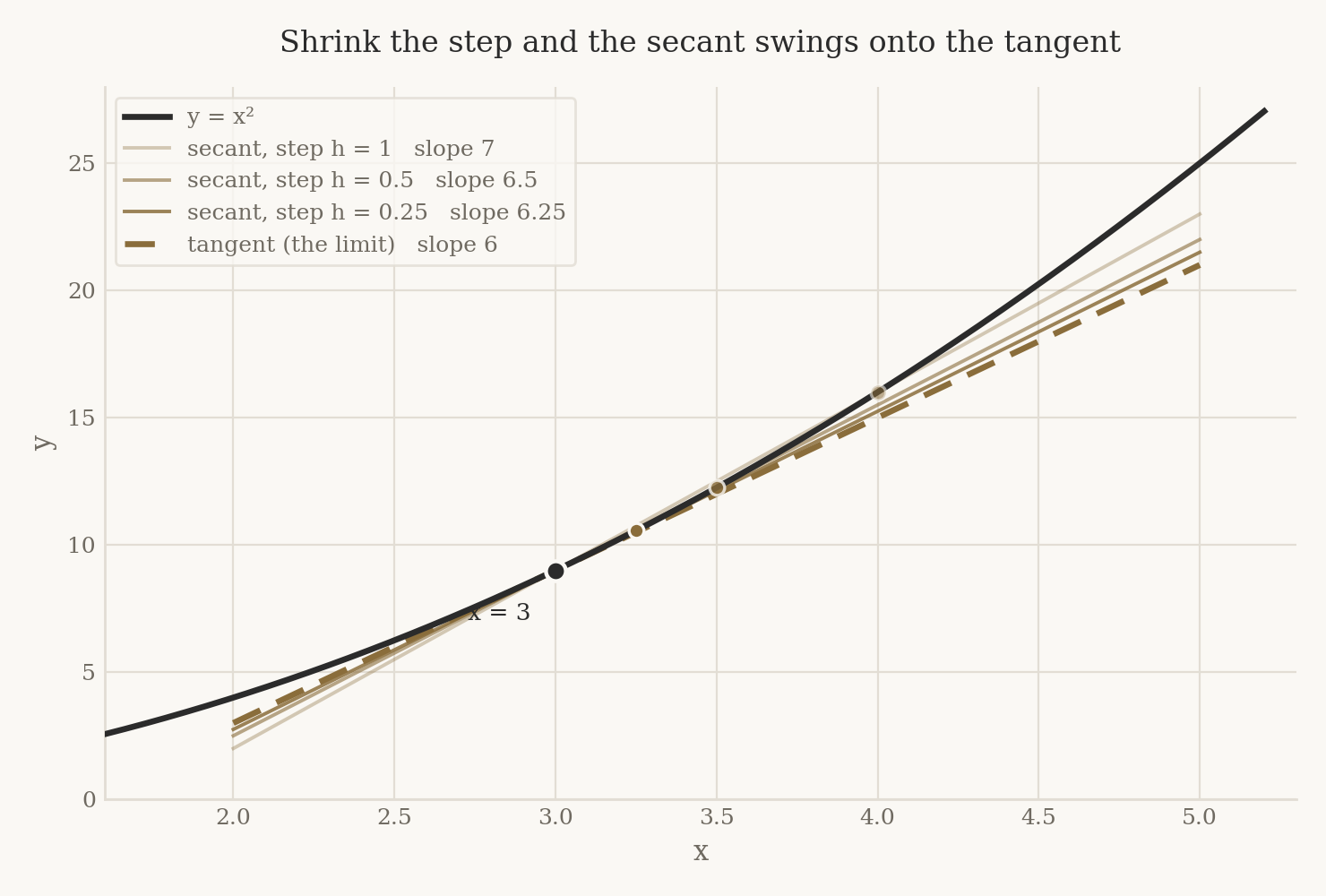
Take the curve f(x) = x². At x = 3 it has the value 9. I want to know how fast it is climbing right at x = 3. So I step a little distance h to the right, see how much the curve rose, and divide by how far I stepped:
Now shrink h and watch:
| step h | rise ⁄ run |
|---|---|
| 1 | 7 |
| 0.1 | 6.1 |
| 0.01 | 6.01 |
| 0.001 | 6.001 |
The answers are crowding toward 6. And the algebra says why. Expanding (3+h)² gives 9 + 6h + h², so the numerator is 6h + h², and dividing by h leaves:
So the answer is always 6 plus however big your step was. Make the step small and the answer sits just above 6. Make it smaller and it sits closer still. It never arrives at 6 for any actual step, because that would mean h = 0 and we would be back to 0 ⁄ 0. But 6 is unmistakably the number being approached, and we call it the limit.
A limit is the number the answers are heading toward, whether or not anything ever gets there.
4 The derivative
That limit has a name. It is the derivative of f at that point: the rate of change at an instant rather than across an interval. It is written f′(x), said “f prime.” We found that for f(x) = x² the derivative at 3 is 6.
Geometrically it is a slope. Draw a line through two points on the curve and you get a secant, whose slope is the average rate between them. Slide the two points together and the secant pivots until it just grazes the curve at a single point — a tangent — and the slope of that tangent is the derivative. That is what the animation on the poem page is showing.
Nobody computes these from scratch. There are rules. The only one you need here is the power rule: bring the exponent down in front, and reduce it by one.
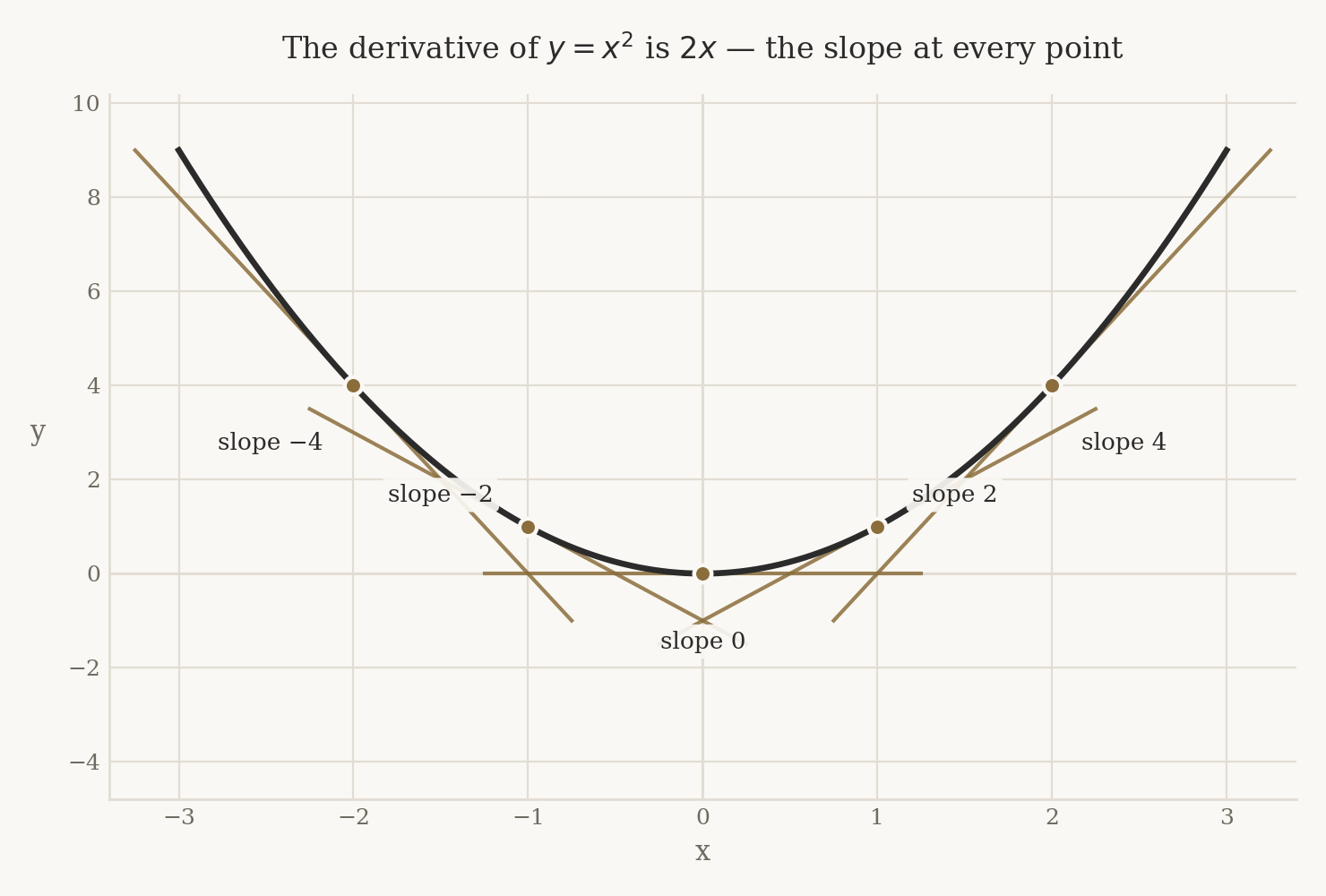
- x² becomes 2x — and at x = 3 that is 6, which is what our table found
- x³ becomes 3x²
5 Doing it twice
A derivative is just another function, so it has a derivative of its own. That one is the second derivative, written f″. In words: the first tells you how fast the thing is changing, the second tells you how fast that is changing.
The familiar example is a falling rock. Let its position be x = ½at², with a the constant pull of gravity. Apply the power rule twice:
- position x = ½a t²
- velocity first derivative v = a t
- acceleration second derivative a
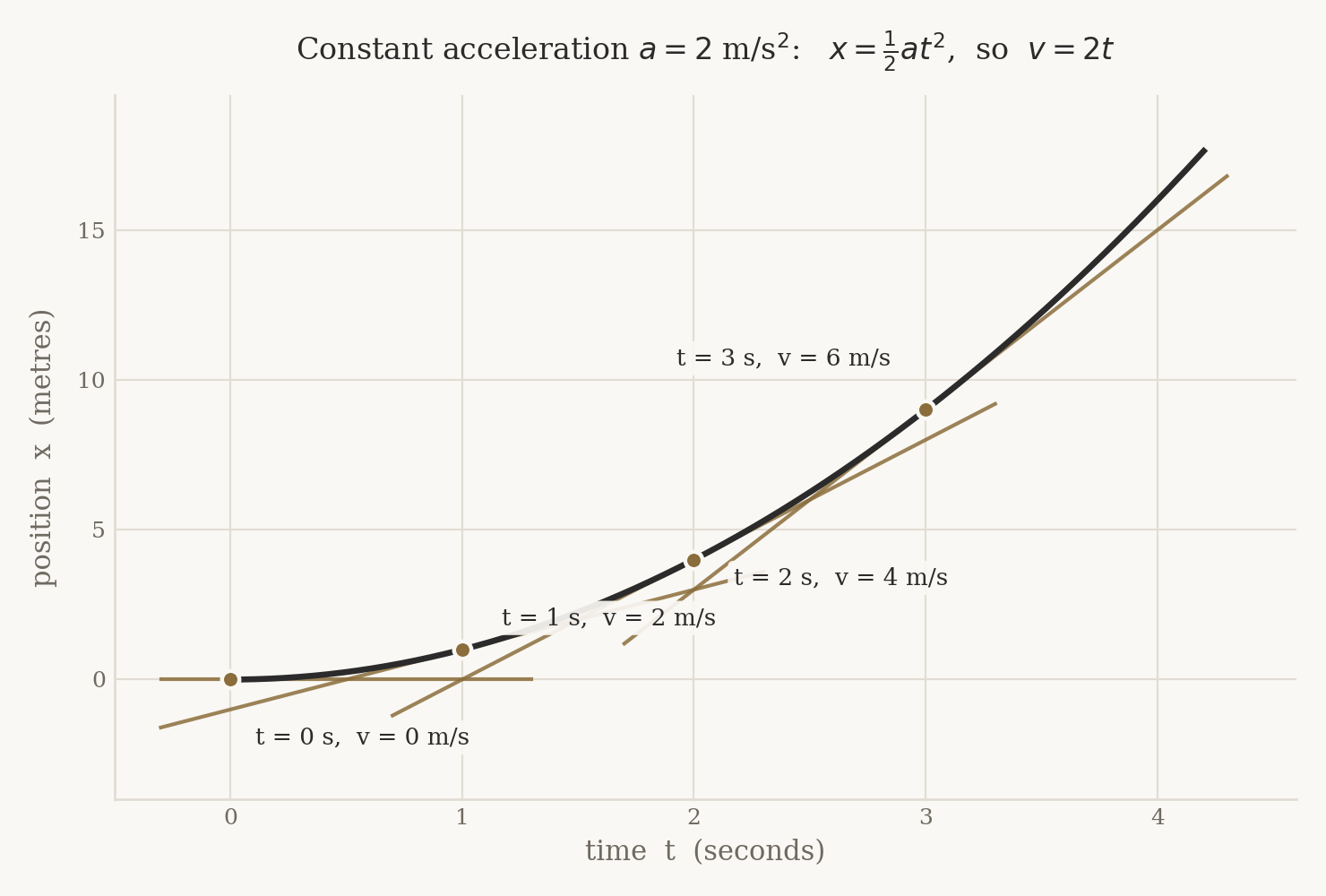
Which says the rock's speed grows steadily and the rate of that growth never changes. Position, velocity, acceleration — a thing, its rate, and the rate of its rate. That trio is where your poem started.
6 A different kind of growth
Now the part that matters most, and it needs no calculus to feel.
The rock's acceleration is imposed from outside. Gravity does not consult the rock about how far it has already fallen — the pull is the same at the top of the drop and the bottom.
Compare a savings account at 5% interest. Here the growth does depend on the current amount. A thousand pounds earns fifty a year. A million earns fifty thousand. The bigger it is, the faster it grows, and the faster it grows the bigger it gets.
Populations do this. Compound interest does this. Rumours do this. And it raises a strange question: what function has a derivative proportional to itself? Squaring will not do it — x² differentiates to 2x, a different shape entirely.
It turns out one number makes it work, and it is called e, about 2.71828. It is not arbitrary; it is what you get by compounding as finely as possible, the limit of (1 + 1⁄n)n as n grows. And it has the property that defines the whole family:
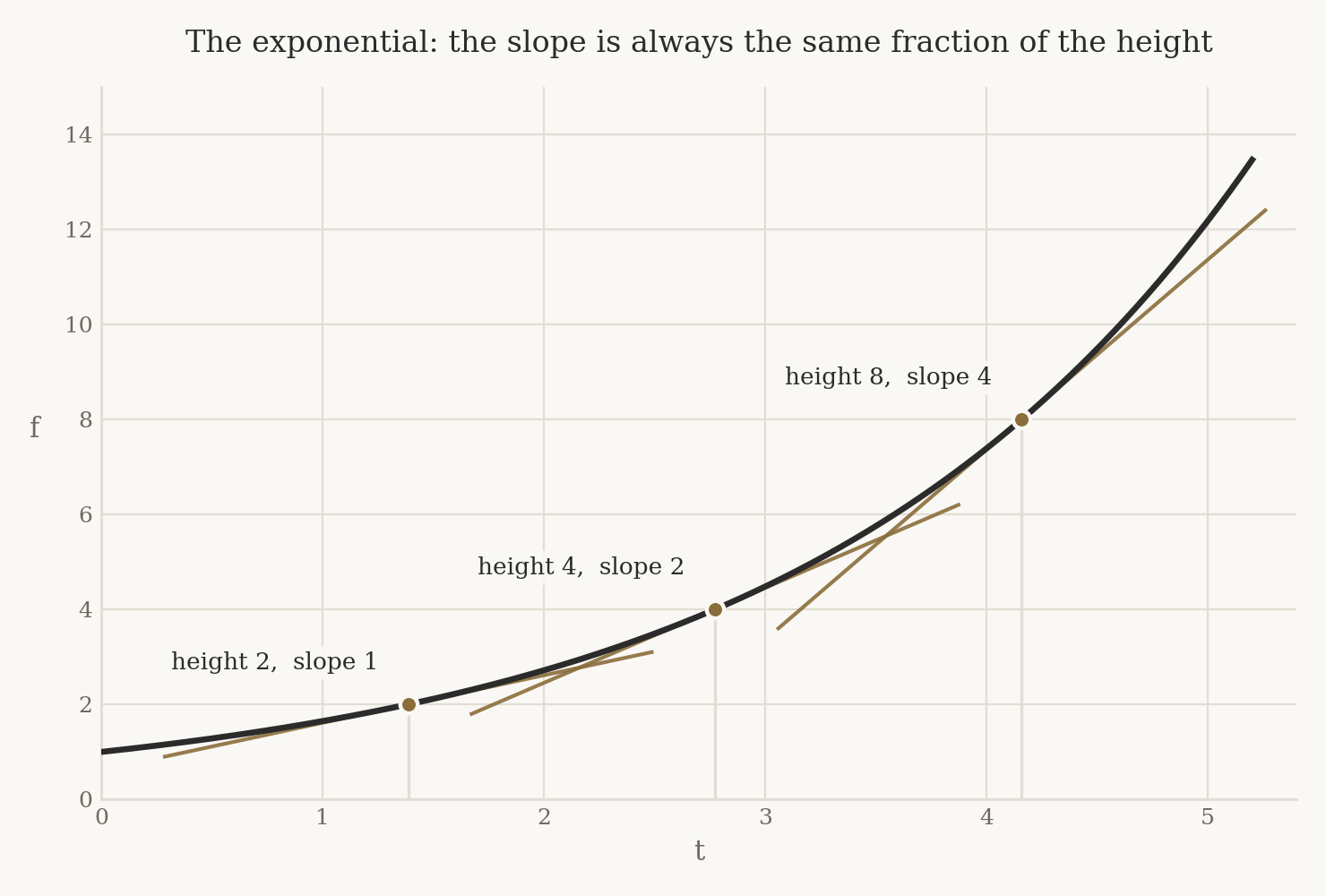
Differentiate an exponential and you get the same curve back, scaled. That is the only family of functions that does this. At 5%, money doubles every 13.86 years no matter where it starts — from a hundred to two hundred takes exactly as long as a million to two million. That is the signature of exponential growth: not a fixed amount added, but a fixed proportion.
7 What a logarithm is for
A logarithm undoes an exponential, the way division undoes multiplication. If e2 is about 7.39, then log 7.39 is 2. That is all it is: the log of a number is the power you had to raise e to in order to get it.
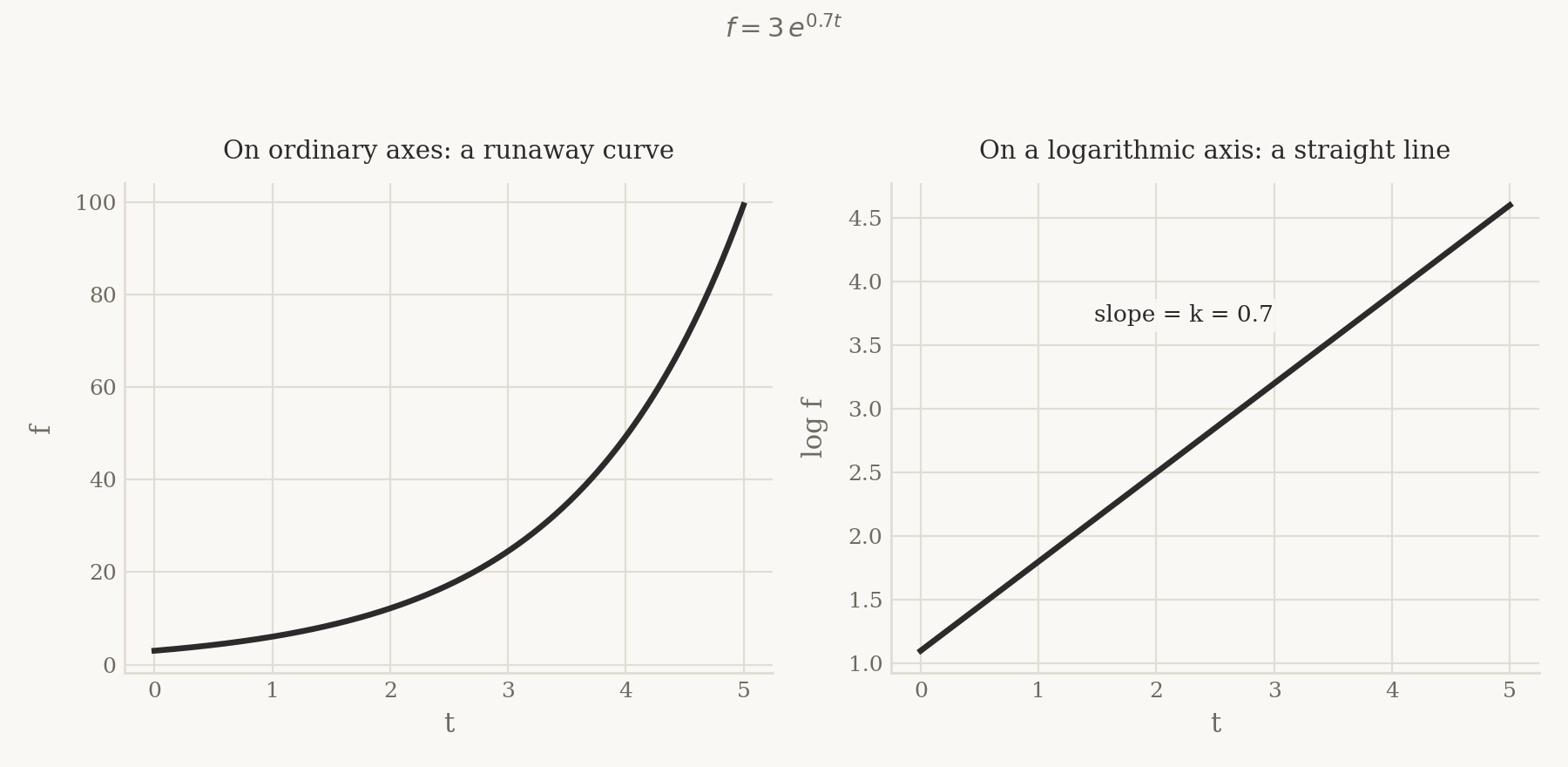
The useful consequence is what a log does to an exponential curve. Take f = Cekt and take its log:
Look at the right side. It is kt plus a constant — the equation of a straight line, slope k. This is why bacteria counts and epidemics get plotted on log paper: exponential growth is a runaway curve on ordinary axes and a tidy straight line on logarithmic ones.
An exponential is exactly the curve that a logarithm straightens.
Hold onto that sentence. It is the hinge of the whole argument.
8 Two rules, stated plainly
I need two more differentiation rules. You do not have to be able to use them; you only need to accept that they work, and both are standard.
Differentiating a logarithm. The derivative of log f is the derivative of f, divided by f:
Differentiating a fraction. For a top over a bottom, the derivative is “bottom times derivative of top, minus top times derivative of bottom, all over bottom squared”:
Apply rule two to the result of rule one — that is, differentiate f′⁄f a second time — and you get the second derivative of the logarithm:
That expression is worth staring at for a moment, because it is about to walk on stage in your poem wearing a different costume.
9 The argument
Here is the poem's structure. Liking, Caring, and the dailey rituals of love stand as a thing, its rate, and the rate of its rate — a function and its first two derivatives:
Cross-multiply, exactly as you would with any proportion — multiply each side by both denominators:
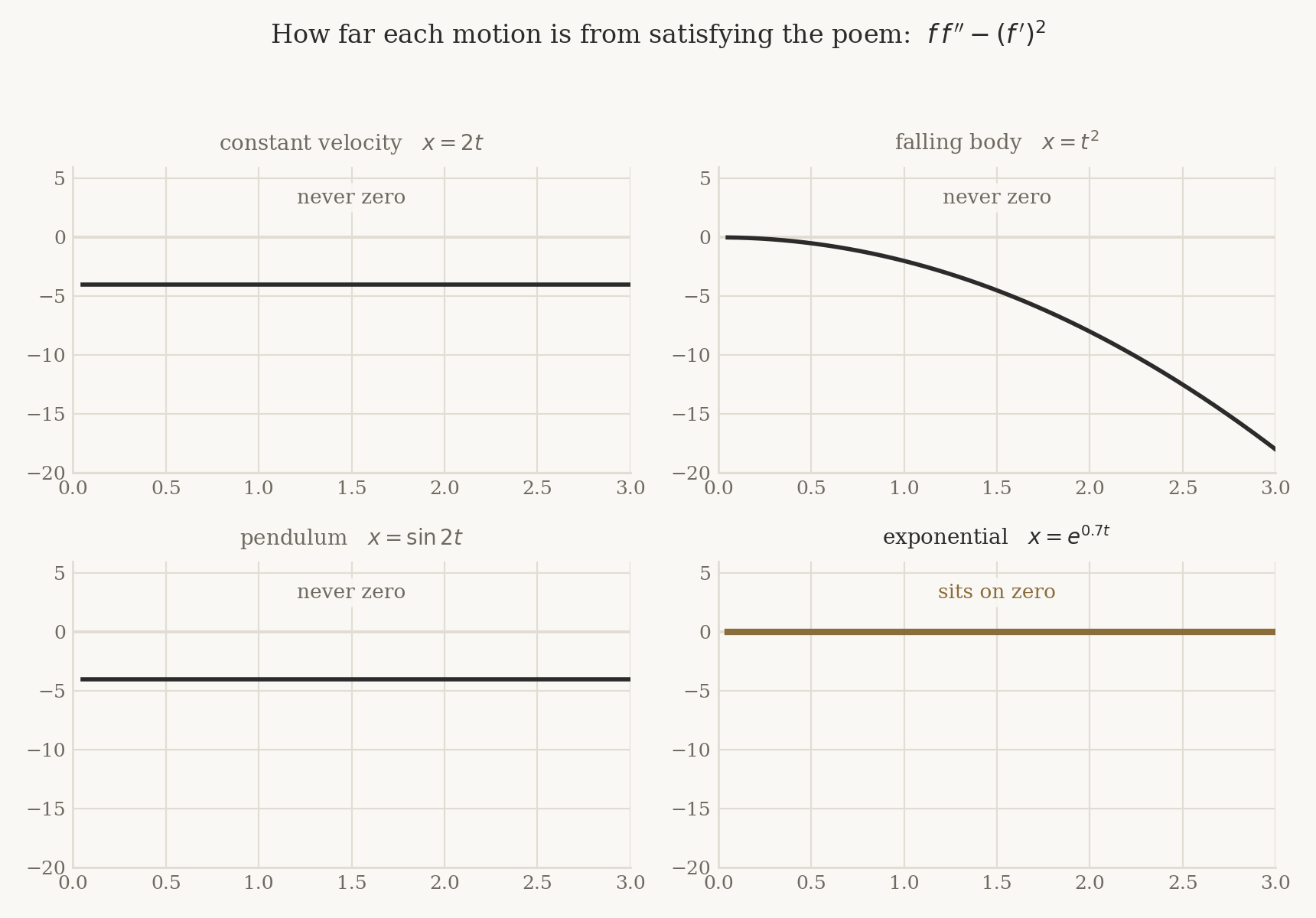
First, the honest bad news. This is not a general fact about motion. Test it on the standard cases by working out both sides — if the proportion held, the difference would be zero:
| motion | f f″ − (f′)² | |
|---|---|---|
| constant velocity, x = v0t | −v0² | fails |
| falling rock, x = ½at² | −a²t²⁄2 | fails |
| pendulum, x = A sin ωt | −A²ω² | fails |
| exponential, x = Cekt | 0 | holds |
Only the last one survives. Which is the clue.
Take the cross-multiplied equation and move everything to one side, then divide through by f². Dividing by something that is not zero cannot change whether an equation is true, so this is a free move:
And now compare that with the last box in section 8. The left-hand side is not merely similar to the second derivative of the logarithm. It is the second derivative of the logarithm. So the poem's structure is saying:
A second derivative of zero means the rate of change never changes, which means no curvature, which means a straight line. So log f is a straight line. And by section 7, the curve whose logarithm is a straight line is an exponential — that one and no other.
The phantom function is an exponential. The words in the poem are free to be anything. The structure is not: it admits exactly one shape of curve, the one whose rate of growth is proportional to how much of it is already there.
10 Back to the poem
So when you wrote that you found it interesting to ponder the shape of the phantom curve, the curve was in fact already determined — not by the words you chose, but by the form you put them in.
And the shape suits the subject. Caring, on this reading, does not accumulate the way a rock accumulates speed, with the same push applied regardless of what has gone before. It compounds. What arrives is proportional to what is already there, which is why a little of it grows quickly into a lot and why none of it grows into none.
That last point is the geometric mean at work. Solved for the middle term the poem reads Caring = √(Liking × Dailey rituals of love), and a product under a square root collapses to nothing if either factor is nothing. No quantity of liking survives the absence of the rituals; no quantity of ritual survives the absence of liking.
If you remember nothing else. A derivative is a rate of change at an instant, found by watching averages over shrinking intervals. A second derivative is the rate at which the rate is changing. An exponential is the one curve whose rate of change is proportional to its own size, and it is the one curve a logarithm turns into a straight line. Your poem, read as a chain of derivatives, says the logarithm of its phantom function has no curvature — and that is another way of saying the function is an exponential.