What a derivative is
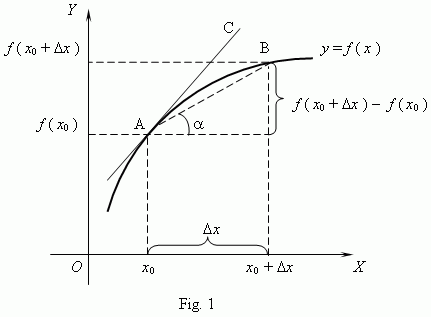
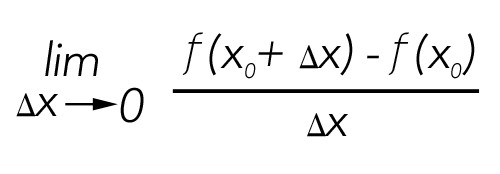
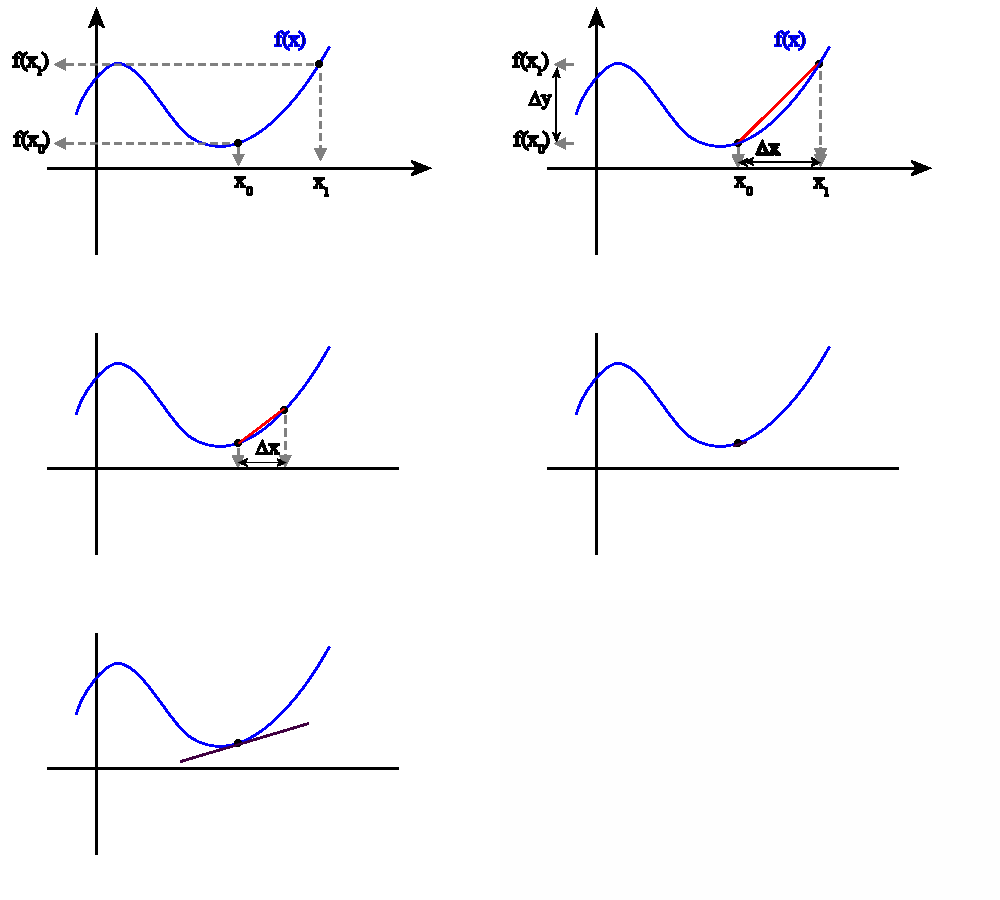
A derivative is the rate of change of one thing as measured by the change in another. Pick two points on a curve and draw a line between them and you have an average rate over that stretch: a secant. Now slide the two points toward each other. As the distance between them approaches zero, the secant swings until it touches the curve at a single point and becomes a tangent, and the slope of that tangent is the rate of change at that instant. That instantaneous rate is the derivative.
You can take the derivative of a derivative. The first tells you how fast something is changing; the second tells you how fast that is changing. The change, and the change in the change.
Where the form came from
The idea came to me while I was reflecting on the equations from physics that describe the relationship between position, velocity and acceleration. Calculus tells us that the first derivative of position is velocity, and the second derivative of position is acceleration. Set those three in a chain of ratios and something appears:
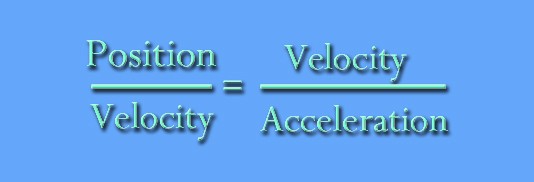
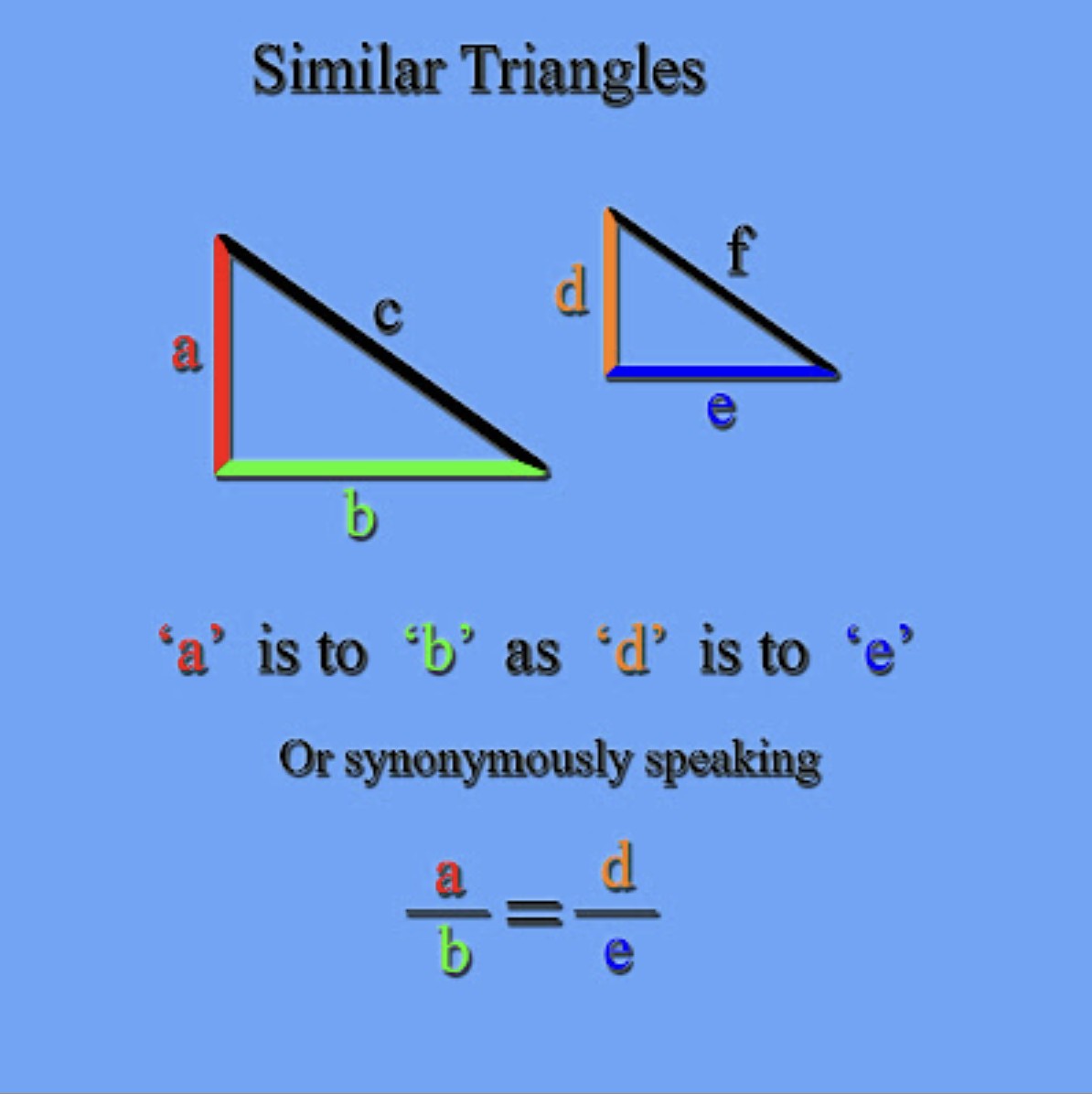
Which is the similar triangles poem arriving from a completely different direction. I had not gone looking for it. Once I saw the ratio form, the poem was already built — it only needed words.
To be exact: physics suggested this proportion rather than supplying it. That x⁄v and v⁄a both carry units of time is what makes the chain feel inevitable — each is a characteristic time, so the proportion is dimensionally impeccable. But it is not a law of motion. It fails for a body moving at constant velocity, for one under uniform acceleration, and for a pendulum. The proportion is a form I took from the shape of those equations, and it turns out to hold only for a particular kind of motion — which is the subject of the last section on this page.
The phantom function
Here is the difference between this form and a piece of mathematics. In calculus the function is explicit: a curve you could draw on a Cartesian coordinate system, with a slope you could calculate at any point.
The double derivative poem addresses the first and second derivatives of what I call a phantom function — a function that is never plotted and never specified. It is to be experienced with your intuition rather than described explicitly as a single curve. You know the thing is changing, and you know the change itself is changing, and the form insists those two facts stand in a fixed relation. It refuses to tell you what the function is.
The structure
Note that the middle term appears twice. In an ordinary similar triangles poem the four terms are distinct; here the first derivative is simultaneously the consequent of one ratio and the antecedent of the next. That repetition is the whole form. It is what makes the chain a chain.
A worked example
Each mathematical term is a word or a phrase, and each is a metaphor relating to the derivative paradigm. The three phrases are mapped into the source domains of the three metaphors, using George Lakoff’s nomenclature:
- Liking IS position
- Caring IS velocity
- Dailey rituals of love IS acceleration
Which gives the poem in its similar triangles form:
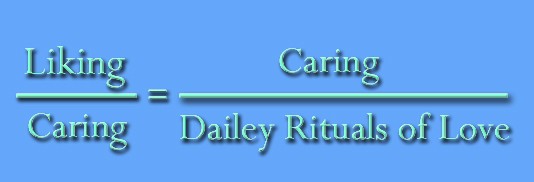
Liking is to caring as caring is to the dailey rituals of love.
Like any equation it can be solved for any of its terms, and each solution is the same poem read from a different seat. Here it is solved for Liking:
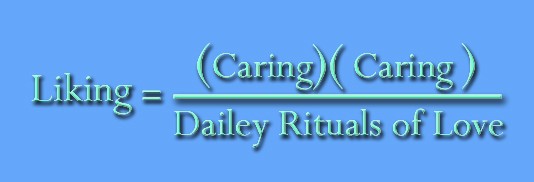
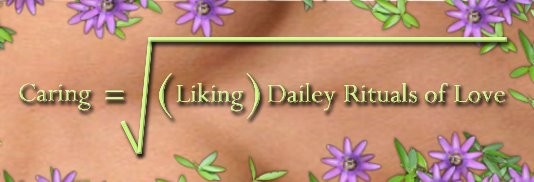
I find the poem more interesting solved for the word Caring, because that is where the geometric mean surfaces — the plate at the top of this page.
Read what that commits to. Caring is not the sum of affection and habit, and it is not a compromise between them. It is their geometric mean — so if either one goes to zero, caring goes to zero with it. No amount of liking survives the absence of the daily rituals, and no amount of ritual survives the absence of liking.
A single point on a curve you cannot see
Visualising the exact mathematical function of “caring as a function of time” would be impossible with the small amount of information given. Yet a single point on that function is present in the poem, even if it is nebulous in form. Other poems could be written to describe other points along the phantom curve. I find it very interesting to ponder the shape of that curve.
The challenge in making a successful derivative poem lies in the poet’s ability to express the proper metaphors to fit the paradigm of first and second derivatives — that is, a change relative to an idea, and then a change in the change relative to that same idea. If all of those requirements are met, one may be able to visualise a point, and part of the nebulous function, graphically in the mind.
The shape of the phantom curve
I wrote above that the form refuses to name its function. That is true of the words. It is not quite true of the mathematics — and I did not realise this until 2026, nineteen years after making the poem.
If the calculus has gone rusty, there is a refresher that builds every piece of what follows from nothing — rates of change, limits, derivatives, the number e, and logarithms — and then walks this same argument slowly, with diagrams.
Write the three terms as a function and its first two derivatives. The proportion f ⁄ f′ = f′ ⁄ f″ cross-multiplies to a condition on the curve:
Only one family of curves satisfies that. Divide through by f ² and the left side is exactly the second derivative of the logarithm:
The logarithm has no curvature, so it is a straight line, so f is an exponential and nothing else. Check it against the physics and the same answer comes back: constant velocity fails the condition, uniform acceleration fails it, a pendulum fails it. Exponential motion satisfies it exactly.
So the phantom curve was never as nebulous as I thought. The words are free, but the structure is not — it admits one shape. The phantom function is an exponential: the one curve whose rate of change is proportional to how much of it there already is.
Which suits the poem better than I could have arranged on purpose. Caring does not accumulate by addition. It compounds — it grows in proportion to what is already present, and that is also why the geometric mean collapses to nothing the moment either liking or the daily rituals goes to zero.
Further out
Now take the idea a little further. A derivative is just the rate of change of one thing as measured by the change in another — and you can have a third derivative, a fourth, and so on. So we could build a mathematical poem whose structure is a string of derivatives, expressed as an expanded similar triangles poem.
That sounds like an interesting challenge. Who is going to be the first to do it, and send it to me?
Double derivative poems
- Liking, Caring, Dailey Rituals of Love 2007