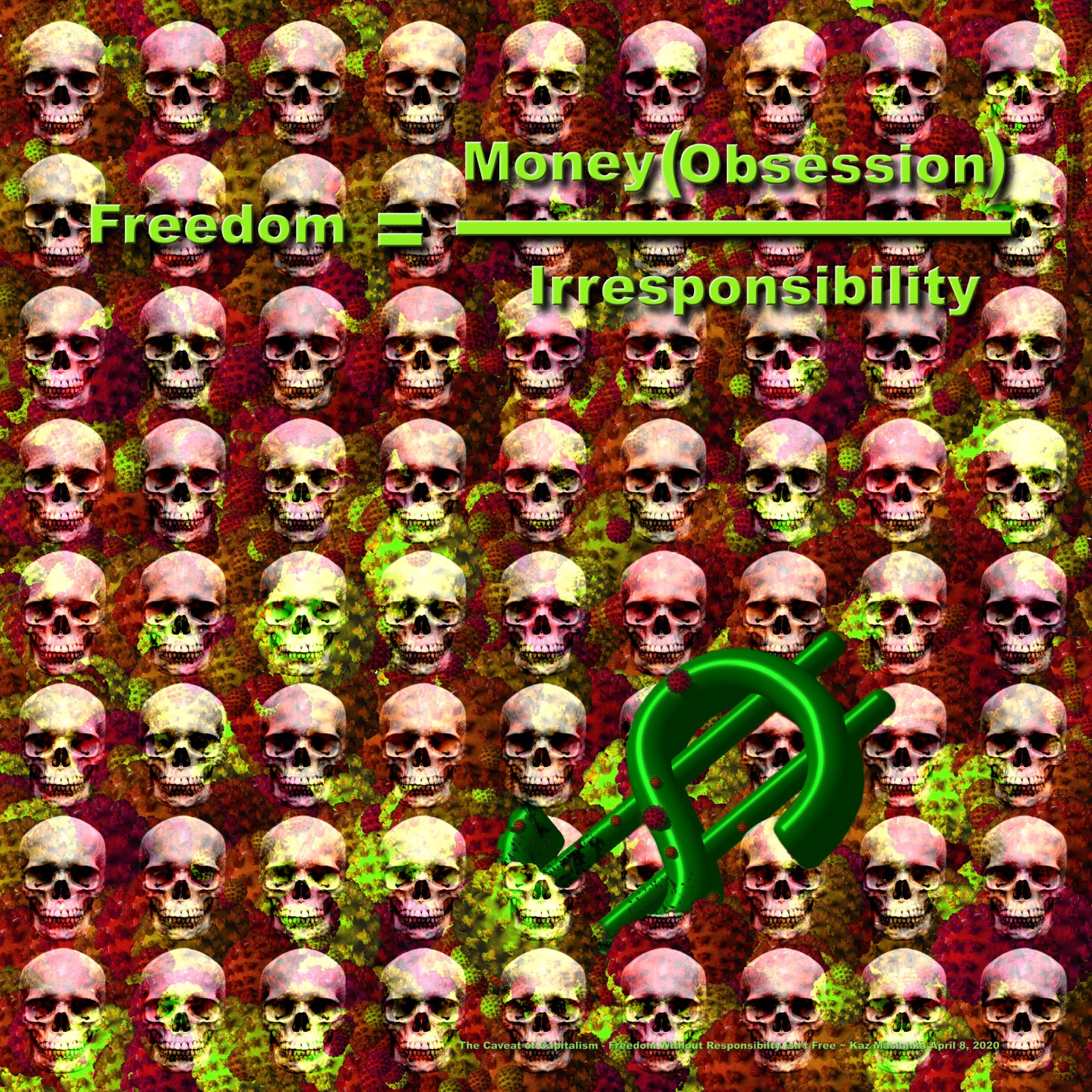
As a mathematical visual poet, I would like to share the inspiration that inspired my piece: “The Caveat of Capitalism — Freedom without Responsibility Is Not Free.” The year 2020 did not start in January — at least not for me. It started in February, right after I purchased N95 masks for my Korean in-laws who flew back home from a vacation with my wife and me.
The Coronavirus invaded planet earth like a cloaked invader from another dimension, mysteriously picking off its victims one by one. I remember the days clearly when my reality just transformed into a B-rated science fiction movie. The virus was spreading across the world, with fatal tragedies manifesting throughout major cities everywhere. Horror stories were coming out of New York City, culminating with the dead being put in refrigerated trucks serving as temporary morgues on the street. Our hearts went out, yet we were helpless and frustrated, for there was nothing anyone could do about it.
Where I live in Southern California, the weather was perfect and the environment paradisiacal, except for the fact that in another dark dimension there was an invader set to kill thousands of people right here in the sun. The confluence of such placid beauty and such eroding evil colored the world such that it was hard to enjoy. Anxiety crept into every situation, affecting everything from business to marriages.
As Americans, we needed someone to lead the charge against this invader, yet instead we had a president who denied its severity and initially charged that it was a political conspiracy. I suspect that the leadership was well over their heads and tried to cover it up by focusing on an easier target. So instead of refocusing on the pandemic, the spotlight moved on to the financial hardship experienced by almost everyone. Thus, a conflict of values was created, politicized, and sold to the American public for billions of dollars in media revenue.
The response of the United States government was troubling at best and selfish incompetency at worst. Yet the problem was much worse than the poor performance of an inept government — for the confluence of social media and capitalism-run-amok created a nightmare from which we have not awoken, and I suspect we will not wake for many years.
One person’s freedom is another person’s prison
We have been told by many on the right side of the spectrum that one of our biggest virtues is our freedom. Furthermore, we must fight everything and everyone to protect it. Yet few understand the mechanics of how freedom works. Unfortunately, the concept that ‘one person’s freedom is another person’s prison’ is not embedded in the psyche of Americans. For if it were, then we would at least have some notion of tolerance, and some understanding that not everyone views freedom the same way. Furthermore, we would also understand that it is ‘cultural selfishness’ that drives our particular belief in freedom, no matter what that definition is.
Before you jump to a conclusion of what I mean by cultural selfishness, let’s talk about the core concept of culture. Within American society, there are countless cultures within cultures, within cultures — or you may rather use the term subcultures, or tribes. The cultures all differ, but what they all have in common is that the members of the group, no matter how small, all hold the same beliefs and values. And since they all value their beliefs, you can create a concise definition for the ‘nucleus of culture’ as a group of two or more people with the same values.
So it follows that American society values disparate things, with many of those values manifesting in different levels of conflict. The level of the conflict depends on how threatened one feels by the conflict. Since Americans in general value their freedom greatly, it is easy to see why the conflicts among freedom fighters are so intense. Furthermore, many people view their idea of Freedom as American, and anything opposing it as un-American. So it is easy to see conflict across the political spectrum manifesting in everything from trolling on social media to attacking Washington with an armed militia.
No matter what political side you are on, everyone in American society believes that their values are true ‘American values,’ and those values that conflict with their own are a threat to the fabric of society. Therefore, we are all culturally selfish, in that we believe that our values (not yours) are the best for our great country.
Furthermore, if you force your values upon me, then I lose my freedom in the prison of your values. For you will chastise, denigrate, and restrict me from expressing my values. And if I force my values on you, then you have lost your freedom in the prison of my values, for I will chastise, denigrate, and restrict you from expressing your values. Therefore, the concept of Freedom is not absolute — it is cultural and relative.
The conflict that made the poem
Freedom for any one person comes at a price, no matter what your definition of it is. The definitions of freedom are complex, but ostensibly it doesn’t mean “anything goes.” For it is easy to see that an ‘anything goes’ mentality is arguably selfish and irresponsible, yet so many Americans possess this destructive obsession.
As all of our institutions became politicized, businesses failed, and COVID-19 deaths accumulated, conflicts of values bubbled up to the surface of society quite early in the pandemic. Political rhetoric exacerbated the conflicts, politicizing something that should not be political. The conflict that inspired the piece shown in this introspection was human lives versus business and, by extension, money. Battles ensued among topics that included everything from wearing masks to being able to open the pandemically closed doors of businesses.
The ideal of Freedom erected itself into the spotlights, promulgating the conflicts to the center of the stage for political partisan battles. Sadly, the values of generosity and altruism never made their way into these conversations. In my frustration, I was inspired to create the mathematical visual poem titled “The Caveat of Capitalism — Freedom without Responsibility Is Not Free.”
How to read the poem
To fully appreciate the confluence of diverse disciplines, one must always do some homework. While much art requires no foregrounding, mathematical visual poetry requires some basic algebra skills, as well as an open willingness to understand how poetry is used in this way. It is beyond the scope of this paper to delve into the mechanics and cognitive linguistics involved in fully enjoying this piece. I have provided a link below that will fill in all of those blanks. Yet I will introduce this piece with the bare-bones approach, while hoping that you will further investigate this form of poetics.
The piece shown here uses the same mathematical structure that is used to calculate the lengths of the legs in a pair of similar triangles. That is, ‘a’ is to ‘b’ as ‘d’ is to ‘e’, or in equation form as a/b = d/e.
If we solve for ‘a’, then we get the form used in this poem: a = b(d)/e, or:
In the vernacular, the mathematical poetic part of this expression can be read as such: “Freedom is to Money as Obsession is to Irresponsibility.” Or we can mathematically manipulate the syntax differently to read: “Freedom is to Obsession as Money is to Irresponsibility.”
The visual elements in the piece include a substrate of coronaviruses underlying a layer of seventy-two tessellated human skulls. All these images are symbolically eroded by money.
Cognitive linguistics has given me the language to study this mathematical visual poetic structure in detail. To understand mathematical visual poetry in general, and similar triangles poems in particular, please read the paper “A Cognitive View of ‘Pandemic Meditation’ (A Mathematical Visual Poem)”, published in the Journal of Humanistic Mathematics, Volume 12, Issue 1, January 2022, pages 366 to 386, and republished by Kate Vass Galerie, Zürich, in March 2023.