Start with a palm tree
Here is a man standing next to a palm tree on Mission Beach. If I handed you a tape measure and asked how tall the tree is, could you tell me? You cannot climb it and you cannot reach the top. But you can measure three things on the ground: the man’s height, the man’s shadow, and the tree’s shadow.
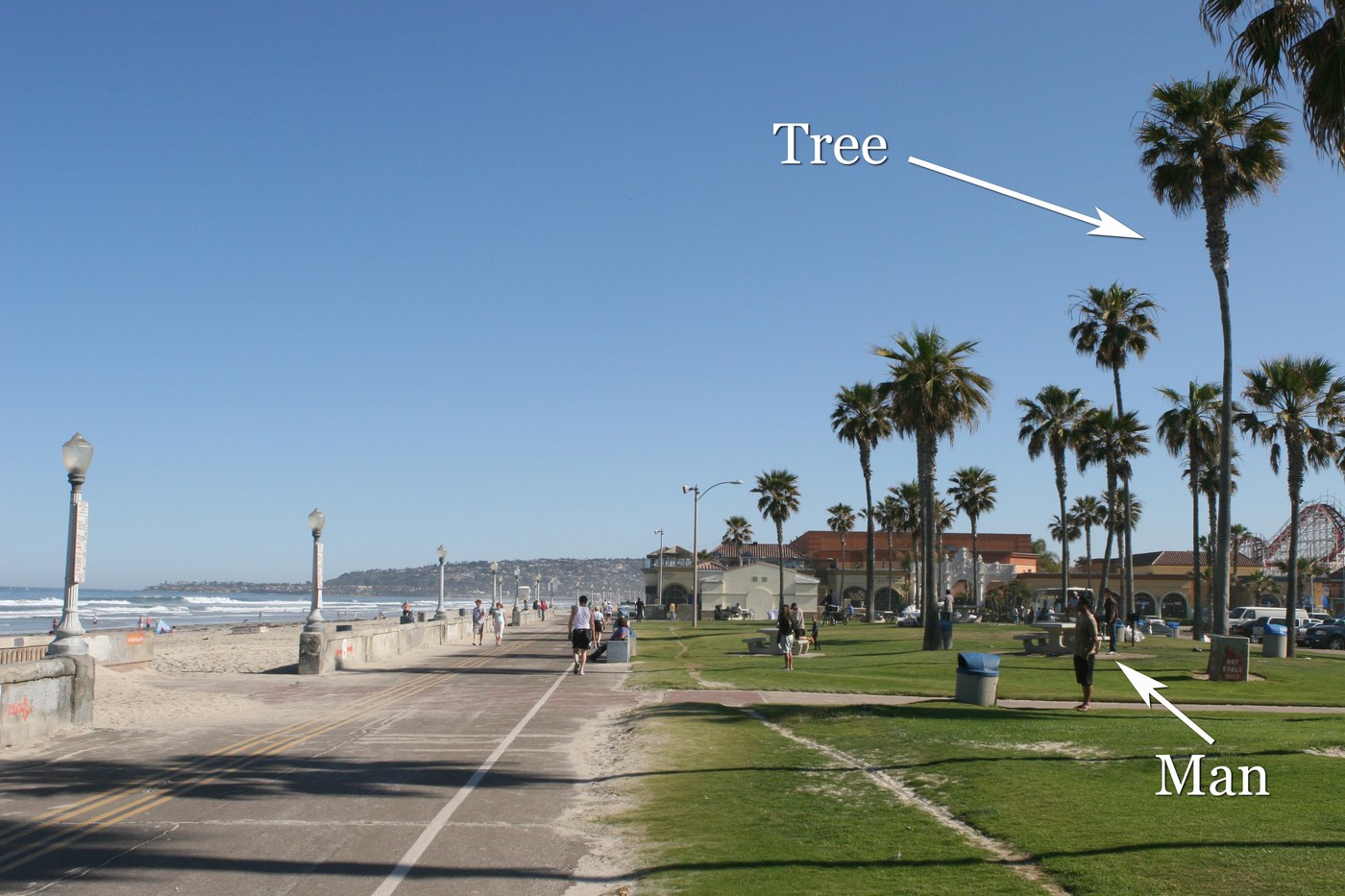
Because the sun stands at the same angle over both, the man and his shadow make a small triangle, the tree and its shadow make a large one, and the two are similar: same shape, different size. The sides of similar triangles hold a fixed proportion.
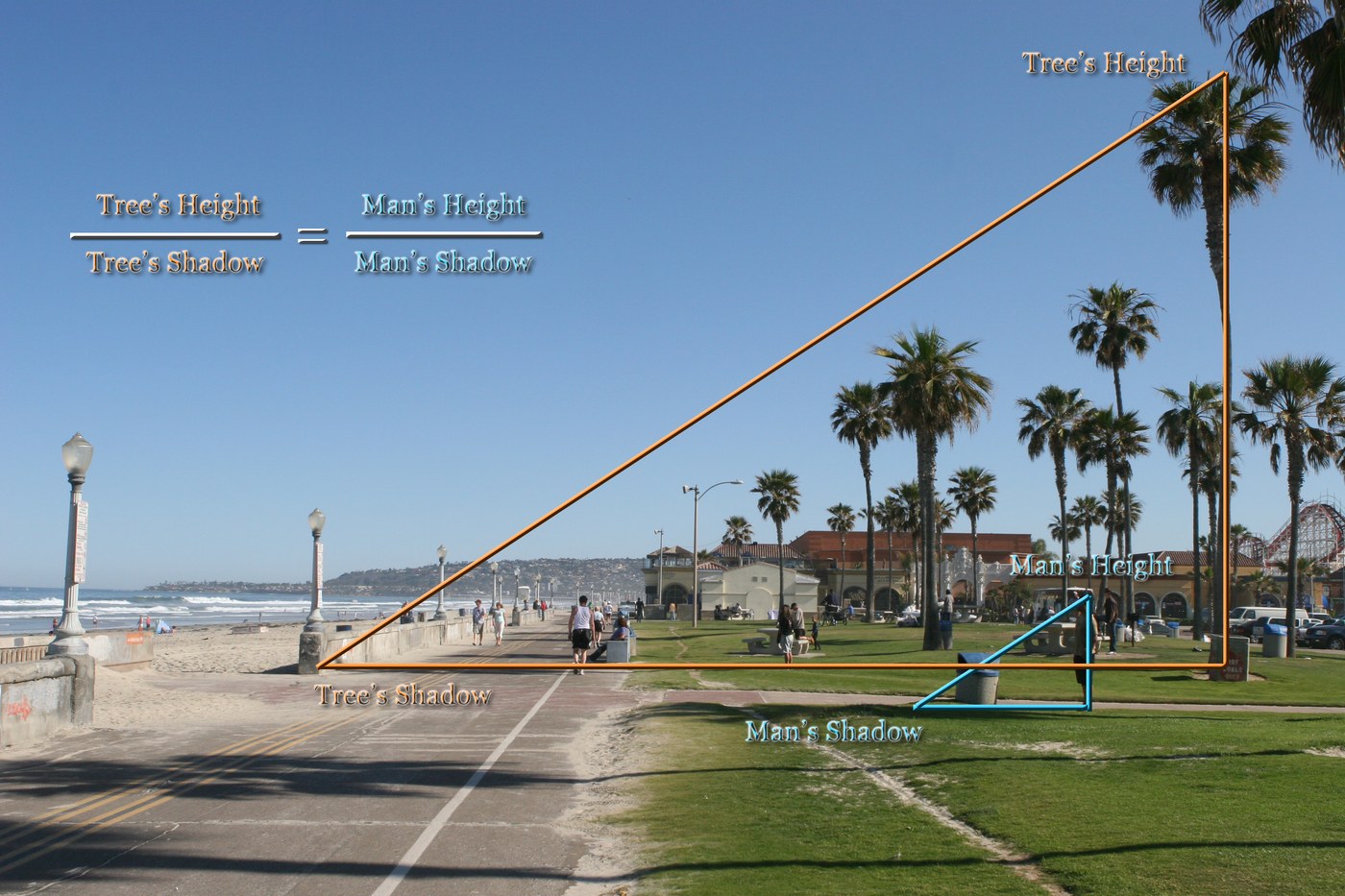
The tree’s height is to the tree’s shadow as the man’s height is to the man’s shadow.
Measure the three you can reach, solve for the fourth, and you have the height of a tree you never touched. That is the whole engine of the form. Nothing in it requires the four terms to be lengths.
The structure
I call a poem in this shape a similar triangles poem, and occasionally a proportional poem. But I prefer the first name, because the triangles are not decoration — the geometry itself is doing work, and I will come back to why.
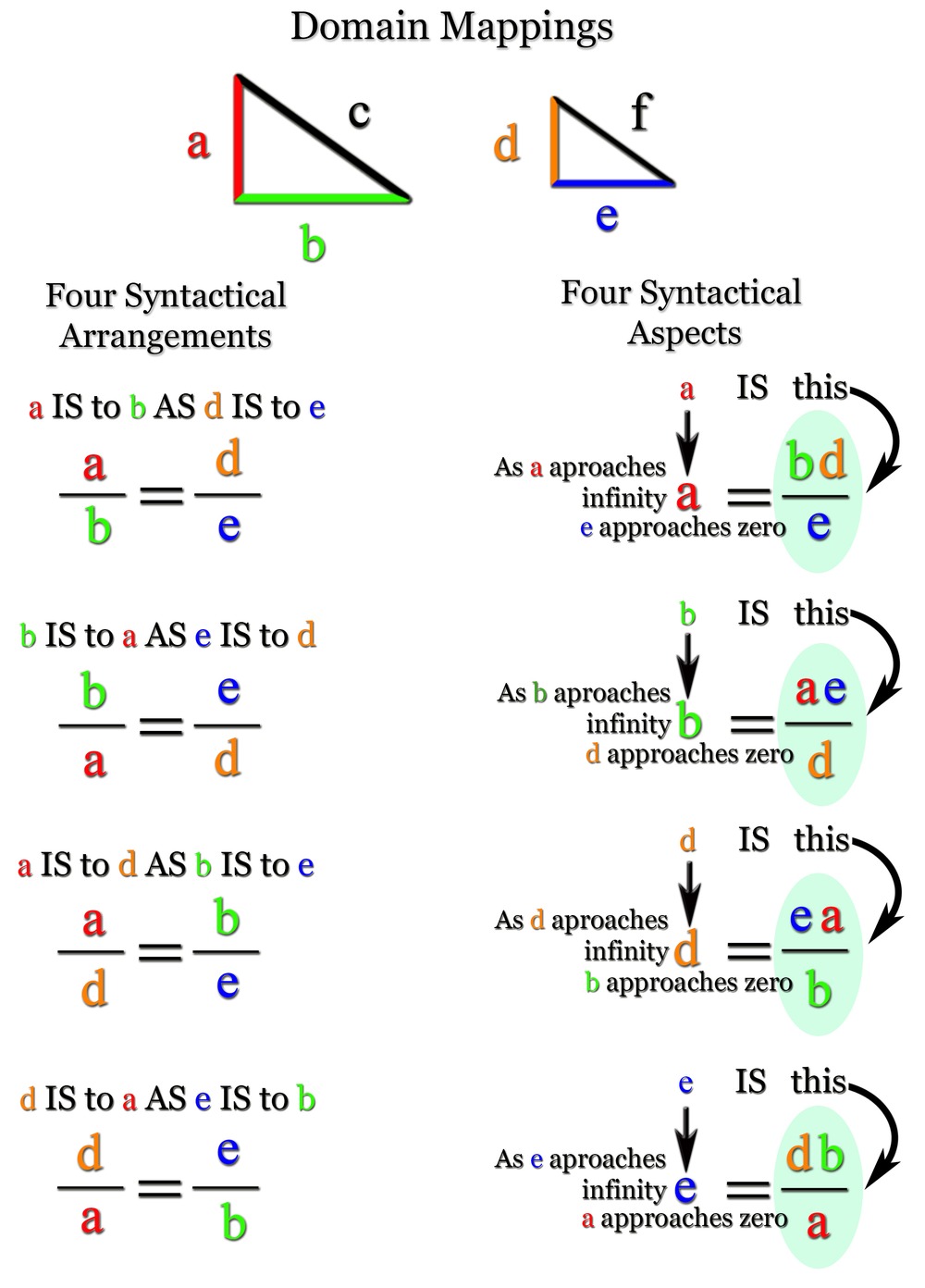
The value of a is to the value of b as the value of d is to the value of e.
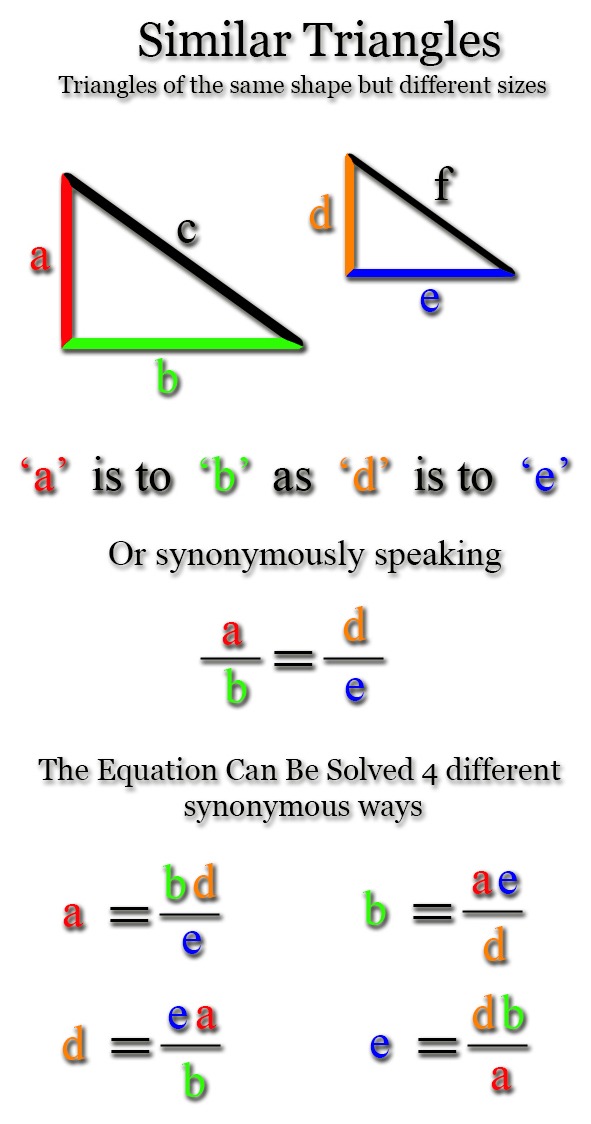
Put four concepts into those four places and the proportion starts making claims about them. Try it with something harmless:
The value of apples is to the value of apple butter as the value of peanuts is to the value of peanut butter.
Nobody has to be taught how to read that. But notice what is actually being compared. Not the things themselves — the values they hold. The poem is not saying apple butter is made from apples, and it is not putting one thing forward as a stand-in for another. It asserts that the value of apple butter relative to apples stands in the same relation as the value of peanut butter relative to peanuts.
And what value means is set entirely by the context you bring — worth, importance, magnitude, scarcity, whatever the reading calls for. Weigh those four terms by price and the proportion says one thing. Weigh them by how much you want them at breakfast and it says another, without a single word changing. The context is doing as much work as the words.
And because the equation solves four ways, that one comparison is already four poems:
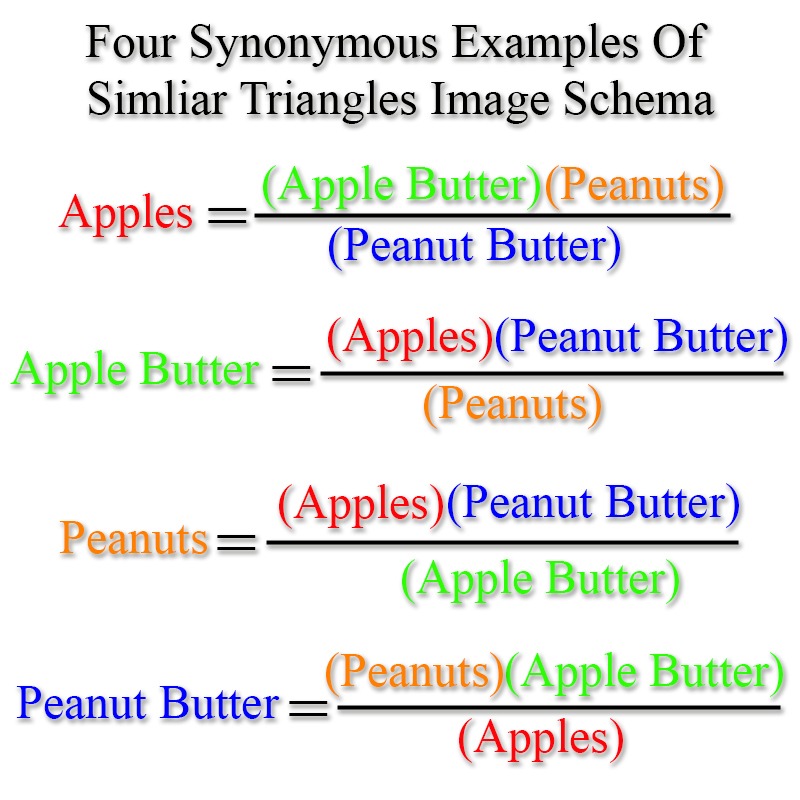
All four are true, and all four are the same claim wearing different syntax. You wrote one of them; the proportion wrote the other three.
Four poems, one meaning
An equation can be solved for any of its terms, so this one yields four arrangements. They are logically identical and syntactically different — the same poem played in four different keys.
- a = bd / e
- b = ae / d
- d = ea / b
- e = db / a
Each has its own way of being said aloud — the value of a is to the value of b as the value of d is to the value of e, and likewise b is to a as e is to d, a is to d as b is to e, d is to a as e is to b — and each puts a different term in the position of the thing being defined.
Two of the four will be reciprocals of the other two, which amounts to swapping the source and target domains and seeing what happens. In practice, if the poem is strong two arrangements will resonate hard and the other two will offer nuances — but a genuinely strong expression will make sense in all four. That is a useful test while you are writing one. If three of the keys are nonsense, the poem is not finished.
The see-saw
The terms are not fixed quantities. Each holds a value that a reader assigns — read it as importance, or magnitude, or intensity — and those values run from zero to infinity with everything in between.
Which means the proportion behaves like a balance. Change the value of one term and another must move to keep the relation true. Drive one toward infinity and its partner goes toward zero. This is where a proportional poem stops being a statement and becomes an instrument: the reader plays it by pushing on the terms.
Why it is a metaphor and not just an analogy
In cognitive linguistics a conceptual domain is any coherent construction of thought — an idea, a concept, a mental construction. A metaphor is a one-directional mapping from one domain onto another, and the naming convention is TARGET IS SOURCE. We understand the target in terms of what we already know about the source. Lakoff’s standing example is LOVE IS A JOURNEY, which is why “we’ve hit a dead-end street” and “their marriage is on the rocks” are both available to us without explanation.
The source domain holds the concrete; the target domain holds the abstract. And crucially, Lakoff insists the generalizations governing poetic metaphor are not in language but in thought. They are mappings across conceptual domains. Language is downstream.
So here is what the form provides. The similar triangles supply an image-schema — a general structure of relation — and the four terms supply the conceptual domains. You map across the horizontal bar and across the equal sign, and because the schema is rigid, the mapping cannot be argued with. The geometry guarantees the consistency; the words provide the content.
An image-schema is not the same as an image-metaphor. Image-metaphors map one rich mental image onto another rich mental image — Breton’s my wife, whose waist is an hourglass. Image-schemas are not rich; they are very general structures like bounded regions, paths, centres. Both appear in these poems, and they do different jobs.
The three mechanisms
Lakoff and Turner identify three mechanisms by which an expression works as novel metaphor. My claim is that a successful similar triangles poem uses all three at once, inside a single construction.
- Extension of conventional metaphor — a novel use of a metaphor already living in everyday speech, which lets you understand something common in an uncommon way.
- Image-mapping — superimposing one rich image on another by virtue of some shared structure.
- Generic-level metaphor — particularly GENERIC IS SPECIFIC, where a single specific statement maps onto an indefinitely large number of parallel situations. Proverbs work this way.
An equation is unusually well suited to that last one. A single structure — a = b × c — already generates F = ma, d = vt, V = IR: many specific-level expressions sharing one generic-level form. And within any equation, each variable can take infinite values. The equation sits at the generic level; any particular reading of it is a specific-level schema.
A poem read all the way through
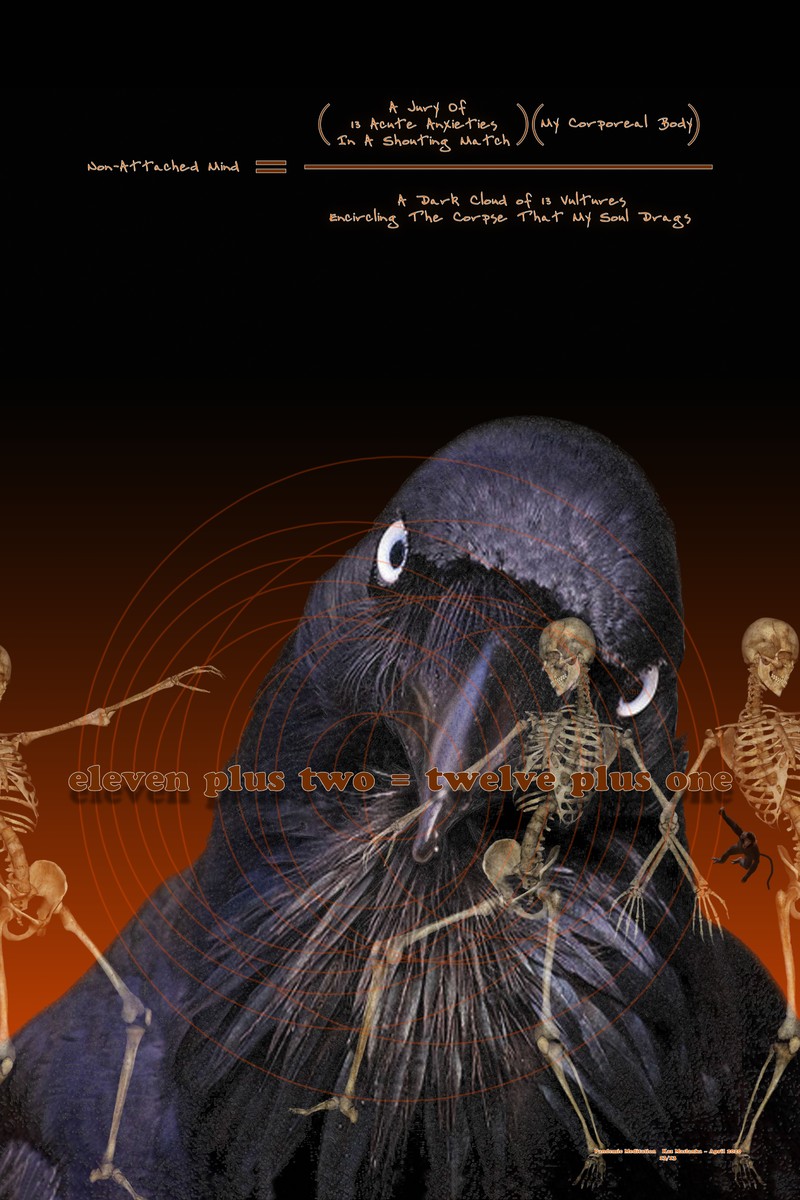
Pandemic Meditation came out of an anxiety-ridden meditation in 2020. I had been watching bodies stored in refrigerated trucks on the streets of New York, and the news cycle would not stop reminding me of my age and of who else was at risk. Meditation keeps me in the present moment, which is where the discontentment inherent in the human condition can be set down — and during that period it was not working. In one session thirteen anxieties went spinning around my mind. Empty, and yet I was attached enough to count them.
The equation
Which is a = bd / e. Restore it to proportion and it reads:
The value of Non-Attached Mind is to the value of A Jury Of 13 Acute Anxieties In A Shouting Match as the value of My Corporeal Body is to the value of A Dark Cloud Of 13 Vultures Encircling The Corpse That My Soul Drags.
Rearrange it and it reads just as well the other way:
The value of Non-Attached Mind is to the value of My Corporeal Body as the value of A Jury Of 13 Acute Anxieties In A Shouting Match is to the value of A Dark Cloud Of 13 Vultures Encircling The Corpse That My Soul Drags.
Working the see-saw
Now push on the terms and watch what the equation is willing to say:
- When Non-Attached Mind becomes near-infinite, A Dark Cloud Of 13 Vultures becomes near zero.
- When A Dark Cloud Of 13 Vultures becomes near-infinite, Non-Attached Mind becomes near zero.
- When A Jury Of 13 Acute Anxieties becomes near-infinite, My Corporeal Body becomes near zero.
- When My Corporeal Body becomes near-infinite, A Jury Of 13 Acute Anxieties becomes near zero.
Non-Attached Mind can be a mind of enlightenment or a mind in hell, and everything between. The proportional schema is what forces the trade: change the importance of one domain and another has to give.
The three mechanisms, in this poem
Extended conventional metaphor. Mapping the source domains — the dark cloud of vultures, and my corporeal body — onto the targets of the jury of anxieties and the non-attached mind is an extension of the conventional metaphor MIND IS BODY. Solve the equation in its various ways and you read that one metaphor in expression after expression.
Image-mapping. The similar triangles map one to another, which keeps the image-schema consistent across every arrangement. And the thirteen circles running between the letters of the anagram map to the thirteen anxieties and again to the thirteen vultures — the same circling schema, three times over. The vultures map to the skeletons, which map to the raven, and all three connect to death. The Buddhist idea of monkey mind — the disquieted mind — maps onto the circles as a path for the monkey to follow.
Generic-level metaphor. Vultures are conventional symbols of death, giving us DEATH IS A DEVOURER; and mapped through this poem, DEATH IS ANXIETY. Not thirteen omens of death but countless ones — one for every anxiety met during a pandemic.
There are container-schemas nested inside the larger schema too: in a shouting match and encircling the corpse that my soul drags. Image-schema within image-schema.
And the anagram across the middle of the piece is an equation in its own right. Eleven plus two and twelve plus one use the same thirteen letters, and both sides come to thirteen. It is simultaneously a true anagram and a true equation.
Where the beauty is
For me it sits in an alternating cognizance between two experiences: the pleasure of analysing the cross-domain mappings inside the similar triangles image-schema, and the conflation of lexical with sensorial visual imagery. Neither on its own. The moving back and forth.
The point of setting all this out is not to explain any particular poem — explanations of poetry serve only to kill them. It is to hand you the tools, so you can go and build one.
Similar triangles poems
- The Vortex of Delusion 2008
- The Gift of San Shin 2008
- Phanes’ Doctrine Of Negentropy 2008
- Ghost Stories 2009–2018
- The Tao of Campbell 2010
- Singularity At Vulture Peak 2010–2014
- Obscuration, Contention In The Persistence Of Self 2012–2026
- Hwadu 2014
- No Quarter // No One To Blame 2015
- The Pedagogy of Moonlight 2016–2022
- Delusions Of Control 2018
- The Rape Of Nicaea 2018
- The Metrics of Faith In Niels Bohr’s Dreamstate 2019
- Pandemic Meditation 2020
- Covid Kalfu 2020
- Disengendered 2020
- The Caveat of Capitalism 2020
- The Gift of Entropy 2022
- El Puente Del Corazón 2022
- Hatriotism And The Zombie Apocalypse 2022
- The Aesthetics of Rain 2024
- The Epistle of Timo 2024
- The Pervasion of Breath 2024
- The Sirens of Anarchy 2025
- The Wake Of Lightning In The Poet’s Retreat 2025
- The Land of Belief 2026
- Emergence 2026
- The Commensurability of Honor 2005–2026